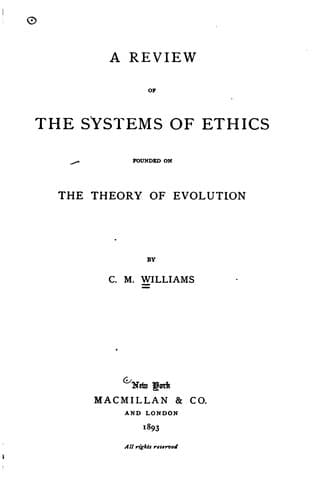
A Review of the Systems of Ethics Founded on the Theory of EvolutionWilliams, Cora May
Philosophy
A Review of the Systems of Ethics Founded on the Theory of Evolution
Williams, Cora May
Ethics, Evolutionary
Can one do more than one's duty? From the standpoint of ethical systems
which are founded on authority or any outward principle, this question
may be answered in the affirmative. The Roman Catholic Church
distinguishes, for instance, between that which is commanded and that
which, beyond the command, is merely advised. But he who follows an
inward sanction cannot but feel that he has done no more than his duty
when he has done all that lies in his power for the welfare of mankind.
It may be right, from a pedagogical standpoint, to give especial praise
to actions that tower above the usual; he who performs them, however,
only then possesses the right spirit when he feels that he has done no
more than his duty, and could not have done otherwise. Even from a
pedagogical standpoint, the difference between duty and merely
counselled action, beyond the duty commanded, can be only a relative
one; that which is, upon a lower plane of development, merely advised,
becomes, upon a higher plane, one of the most elementary duties; mercy
to the conquered may be a high virtue in a savage, but to the civilized
man it is a primary rule of morals.
It is of the highest importance to keep in mind the fact that conscience
itself is a cause, and that ethical judgment, arising as a feeling,
takes part, by its influence upon the will, in the ethical evolution
towards highest welfare. Keeping this in mind, it is easy to see that
Ethics not only calls for no limitation of the law of Causality, but
that such a limitation would be pernicious, even destructive, to Ethics.
There are at least six different significations in which the expression
"freedom of the will" may be used.
It may be used to denote absence of outward constraint; but this might
rather be called a freedom of action than a freedom of the will.
It may be used to denote absence of inner constraint; the will which
springs from pain or fear is often called unfree in distinction from the
will which springs from pleasure or hope.
It may refer to energy and vitality of the will. Here the stress is laid
upon the amount which the will can accomplish, not, however, upon its
independence of causes. One can be a determinist and yet concede that
the will plays an important part in the world; or one can be an
indeterminist and yet assume that free will plays but a small part in
the world.
By freedom of the will is often meant the power of choice. This freedom
is not opposed, however, to causality, but to blindness of action,
subjection to momentary impulses. "Free will" denotes, in this case,
self-conscious will.
Or the word "freedom" may refer to the will as ruled by ethical motives.
In this sense, only the good man is free. This significance of the word
is the oldest, comes down to us from Socrates, and is used by Augustine,
Spinoza, and many others.
Public-domain text, read in full here on John Shaqi.
Reviews
Reviews
No reviews yet
Be the first to share your thoughts on this work.
Elsewhere in the archive
Join the Discussion
Join the discussion
Sign in to leave a comment or review.
Sign InorCreate an account