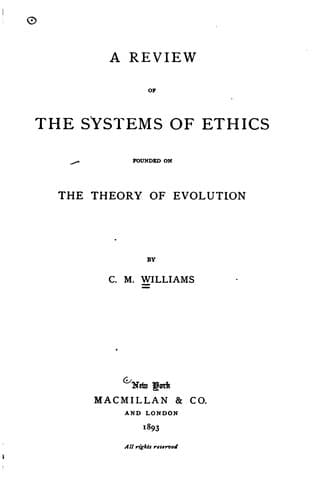
A Review of the Systems of Ethics Founded on the Theory of EvolutionWilliams, Cora May
Philosophy
A Review of the Systems of Ethics Founded on the Theory of Evolution
Williams, Cora May
Ethics, Evolutionary
The ethical end as welfare is not to be conceived as a state of
continuance on the same plane. Such a continuance is impossible;
evolution does not stand still; every step of progress creates new
needs, the satisfaction of which again demands endeavor; perfect
satisfaction is impossible. Even the development of sympathy makes it
easier to wound us in many ways and brings us larger duties. The need of
variety alone would make continuance upon one plane impossible; we labor
not only in order to arrive at conscious ends, but also in order to
relieve ourselves of accumulated energy. The highest end that we can
conceive is a progress in which each step is felt as a good because it
affords scope for action without over-exertion.
Activity is also welfare. But it is so only in so far as it is healthful
activity; when the powers are over-exerted or dissipated in action,
having no common end, or when their application in one direction is at
the cost of other more important directions, progress ceases to be
welfare. The evolution of civilization contains an element of blindness
and heedlessness which is bound up with both its excellencies and its
faults. But civilization is not an act of choice; it is the continuance
of the evolution of nature. Progress is necessary; it is impossible to
remain upon any level attained. Ethics must, therefore, accept progress
as a fact. It does not feel an admiration for an order of nature in
which no advance appears possible without one-sidedness and dissipation
of energy. It is not so hard-hearted that it could forget, in the
seeming splendor of outward results, the anxiety and pain, the sweat and
blood, with which these were won. It demands, therefore, that the heavy
burdens be lightened, the scattered forces united, and all capabilities
that are of worth developed. On the other hand, Ethics is not so
sentimental and short-sighted that it could forget that progress can
take place only through exertion and suffering. Its chief task with
regard to progress is to impress upon the mind the fact that life should
not be made a mere means to the solution of impersonal problems.
Civilization is a means for the individual, not _vice versa_.
Public-domain text, read in full here on John Shaqi.
Reviews
Reviews
No reviews yet
Be the first to share your thoughts on this work.
Elsewhere in the archive
Join the Discussion
Join the discussion
Sign in to leave a comment or review.
Sign InorCreate an account