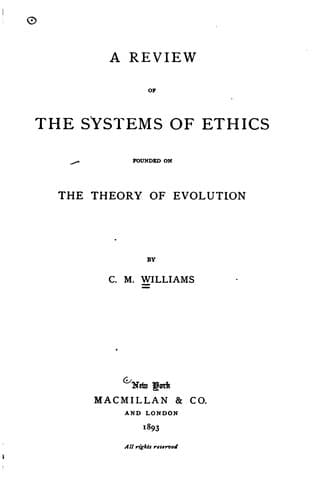
A Review of the Systems of Ethics Founded on the Theory of EvolutionWilliams, Cora May
Philosophy
A Review of the Systems of Ethics Founded on the Theory of Evolution
Williams, Cora May
Ethics, Evolutionary
It is important to note that conceptions develop, in this connection,
faster than feelings. And as long as the former do not find points of
connection with the existing feelings, they will have no practical
influence. The bad consists in the persistence, from inertia or
defiance, upon a lower plane of development after the consciousness of a
higher has arisen. Evil is the animal in man, the remains of an earlier
plane of life. From the instincts of self-preservation and
self-propagation in their most primitive forms, the ethically bad is
produced, and offers fierce resistance to harmonizing influences.
Evil is, furthermore, a sociological phenomenon; the general
psychological elements take on different forms under different
historical conditions; society, in its different forms and functions, is
always one of the determining factors of its development. The criminal
is, like the saint, the child of his time.
It appears, therefore, that the term "bad" is applied from a standpoint
not shared by him to whom it is applied. If the man who stands upon the
lower plane of morals possessed the full and clear consciousness that
the predicate of badness applied to his conduct, the corresponding
feelings and impulses must arise in him, and his conduct be altered. It
is psychologically impossible to act against our fixed and full
conviction, if this is not blunted by other impulses.
The definition of the good must be, on different ethical planes, a
different one. But when a disinterested and universal sympathy
determines the ethical judgment, only that can be good which preserves
and adds to the welfare of conscious beings, increases their pleasure or
diminishes their pain. Every action which tends in this direction
without producing further results of an opposite nature, is authorized;
every action of which the opposite is true is to be rejected.
Since, in general, pleasure is connected with the healthy and natural
use of the powers, with that which preserves and benefits life, and pain
is connected with the opposite of this, Ethics merely continues the work
begun by nature, in aiming at human progress, at as rich and harmonious
a development of human powers as is possible. The problems of Ethics
concern, therefore, the pleasures of the moment as well as those of the
whole life, the pleasures of the individual as well as those of the
whole species. This remains true even if we accept the pessimistic view
that all life is pain; the good would consist, from this point of view,
in as great alleviation of pain as possible. Even the ascetic tortures
himself only in order to gain greater good.
Public-domain text, read in full here on John Shaqi.
Reviews
Reviews
No reviews yet
Be the first to share your thoughts on this work.
Elsewhere in the archive
Join the Discussion
Join the discussion
Sign in to leave a comment or review.
Sign InorCreate an account