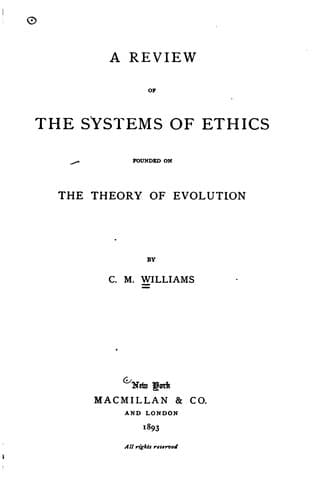
A Review of the Systems of Ethics Founded on the Theory of EvolutionWilliams, Cora May
Philosophy
A Review of the Systems of Ethics Founded on the Theory of Evolution
Williams, Cora May
Ethics, Evolutionary
natures, while light-minded people have easily found means of escape.
The view that the artist occupies a peculiar position in his ideal
world, must free himself from the actual world, and live only for his
ideal, is ethically false; art should lend form to actual life, defining
and clarifying it, broadening the view and educating sympathy. A great
artist is, at the same time, half a prophet; his whole people and epoch
must learn to know themselves through him. Freedom is to be regarded as
both means and end. A representative government is not only an education
for the people, who through freedom alone can learn to use freedom, but
affords the state, moreover, a firmer foundation in the consciousness of
its citizens that they are responsible for the existing condition of
things.
The development of conscience in force and extent takes place through
thought and imagination. Knowledge alone is not enough; it must be fixed
by exercise,--made a persistent thought, until it becomes, by means of
the laws of association, such a thought as will easily come in play
whenever the case requires it.
FOOTNOTES:
[77] Trieb.
[78] Selbstbehauptung und Hingebung.
GEORG VON GIZYCKI
"MORAL PHILOSOPHY" ("Moralphilosophie," 1889)
Moral Philosophy has a scientific and a practical office. Its scientific
task is to supply the human being with a clearer, more thorough
understanding, founded on ultimate reasons, of his moral life. Its
practical task is to answer the important question: How am I to act? How
shall I order my life?
It was not left to science first to direct human action. Custom and law
seek to order the doing and leaving undone of the members of society.
Ethical philosophy ascertains means of testing the actually existing
ideas of morality, and thus enables us to better law and custom.
A highest criterion, one only, is necessary, by which to judge of the
morality of a deed. If there were more than one, the judgment might fall
out differently from the different standpoints furnished by these.
When I regard the qualities which I consider morally good, I perceive
that they all have a direction conducive to the general welfare or
happiness; and when I regard the qualities which I consider morally bad,
I find that they all have an aim prejudicial to the general welfare or
happiness.
Public-domain text, read in full here on John Shaqi.
Reviews
Reviews
No reviews yet
Be the first to share your thoughts on this work.
Elsewhere in the archive
Join the Discussion
Join the discussion
Sign in to leave a comment or review.
Sign InorCreate an account