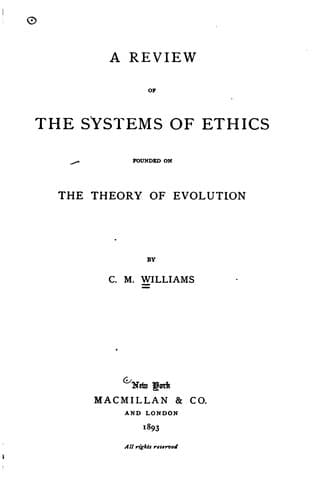
A Review of the Systems of Ethics Founded on the Theory of EvolutionWilliams, Cora May
Philosophy
A Review of the Systems of Ethics Founded on the Theory of Evolution
Williams, Cora May
Ethics, Evolutionary
When I attempt to convince any one that certain conduct which he
considers right is wrong, by showing him that it is opposed to the
general welfare, my final appeal is to his conscience. And in the same
manner, when I correct some of my own moral conceptions, it is my
conscience which determines me to the proof of them, and my conscience
which is the standard that determines my decision. Conscience is the
principle underlying my moral convictions. But I do not possess, in
conscience, a moral power which never errs; hence it behooves me to
judge carefully. Body and mind both have their laws on which depend the
welfare and happiness of society; the last results of science and human
experience give us these laws.
There are few things in regard to which there is so great unanimity as
there is in regard to the right and good. In the fundamental questions,
all the more highly civilized peoples are, for the most part, agreed.
On the lowest planes of civilization, only the narrowest tribal
association is taken into consideration in morals, but gradually, with
the growth of experience, growth of the understanding, which permits the
recognition, in a much higher degree, of the results of action and the
power of sympathy, ever larger circles of human beings are
regarded,--the tribe, the nation, the whole of mankind, all sentient
beings. In this development of conscience and benevolence, there is
nothing to cause moral uncertainty or contempt of conscience; for, in
that case, the fact that there was once a time when human beings were
not on the earth must be a reason for contempt of everything human.
We call various different things good, of worth, others bad, evil; there
must be something common to all these, on account of which we apply the
common term to them. That which is thus common to them is their relation
to a consciousness for which they are good or bad, and not to a merely
perceiving consciousness, but to one that feels and wills. As true and
false relate to the intellectual side of human nature, so do good and
bad relate to the side of feeling and will. Such things are good as are
the mediate or immediate cause of agreeable states of consciousness or
of the prevention or removal of disagreeable states; and on the other
hand, such things are bad as are the cause of pain or the hindrance of
pleasure. We say of these things that they are agreeable or
disagreeable. Or we may use, instead of "agreeable," the term "object
of desire," and instead of "disagreeable," the term "object of
aversion"; for all that is agreeable has an attractive influence upon
the will, and all that is disagreeable or painful has a repellant one.
Joy is that condition of consciousness which we seek to attain and
preserve, whose existence we prefer to its non-existence; and pain is
that state of consciousness which we seek to avoid and destroy, whose
non-existence we prefer to its existence.
Public-domain text, read in full here on John Shaqi.
Reviews
Reviews
No reviews yet
Be the first to share your thoughts on this work.
Elsewhere in the archive
Join the Discussion
Join the discussion
Sign in to leave a comment or review.
Sign InorCreate an account