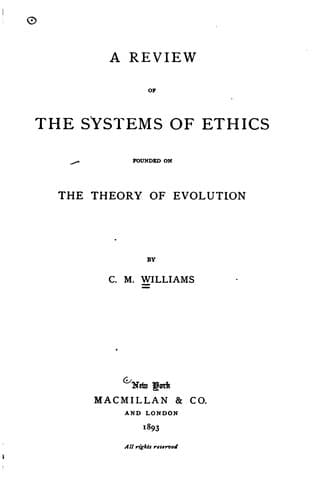
A Review of the Systems of Ethics Founded on the Theory of EvolutionWilliams, Cora May
Philosophy
A Review of the Systems of Ethics Founded on the Theory of Evolution
Williams, Cora May
Ethics, Evolutionary
It is further to be remarked that the proof that an action is
disinterested, is no proof of its moral worth. The worst action,--an
action of pure cruelty, envy, or hatred, may be disinterested, that is,
it may have for its end the pain of another without consideration of the
advantage of the doer.
The effects, as pain or pleasure, of conduct opposed to, or in harmony
with, civil or moral law, in so far as such effects can be predicted
and, as thus predicted, they influence the will, are called Sanctions.
One may distinguish between a physical, a political, a social, a
sympathetic, and a moral sanction. Doubtless the conduct recommended by
self-love, as a result of these sanctions, coincides, to a very large
extent, to a larger extent than egoists in the rule perceive, with that
which the good of society demands; but it is just as certain that, in
many cases, the way of selfish cunning and that of virtue diverge. The
outer sanctions do not insure the coincidence of duty and one's own
happiness; nor does the sympathetic sanction secure this, for sympathy
is often on the side opposed to duty. There is but one sanction which is
ever on the side of action in accordance with duty: the moral sanction,
the peace and joy which accompany the knowledge of having done right.
Duty and self-interest coincide the more nearly, the better and more
unanimous the various sanctions are, and, especially, the more strongly
the moral feelings are developed in a society; one of the tasks society
has to set itself is to labor for the greatest possible concord of duty
and self-interest. But this harmony will never become an absolutely
perfect one and self-sacrifice impossible. Man needs, therefore, some
end which shall depend upon himself alone, if he is to be kept from
discouragement and despair. Such an end is the consciousness of
right-doing. He who chooses this as highest end must devote himself to
the service of mankind, as well as he who makes the advancement of the
good of mankind his end. The thought of this end will prevent him from
being blinded by self-interest in answering the question as to what
right and duty are, and will also preserve him from permitting himself
one or the other pet sin under the excuse that he will atone for it by
other good actions; it will compel him to the endeavor to fulfil every
duty. And though he may not be perfectly happy, he will be happier than
the man who makes the good of humanity his end; since he is less
dependent upon outer events. Benevolence and conscience are not the
same. The latter constrains us to do right, that is, to perform actions
the expected results of which are in harmony with the general welfare;
it has attained its end when the right action is performed, and it has
failed to attain its end when this aim is frustrated. Man has a deep
inner longing for happiness of some sort. When he does not find it upon
earth, he seeks it in some other world. He has often a deep inner
Public-domain text, read in full here on John Shaqi.
Reviews
Reviews
No reviews yet
Be the first to share your thoughts on this work.
Elsewhere in the archive
Join the Discussion
Join the discussion
Sign in to leave a comment or review.
Sign InorCreate an account