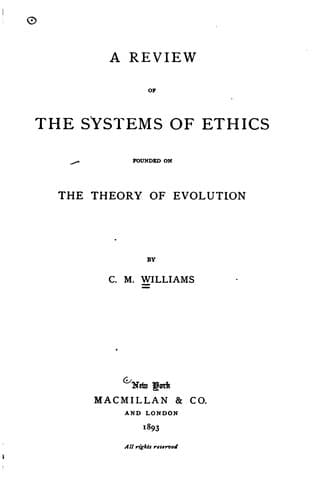
A Review of the Systems of Ethics Founded on the Theory of EvolutionWilliams, Cora May
Philosophy
A Review of the Systems of Ethics Founded on the Theory of Evolution
Williams, Cora May
Ethics, Evolutionary
Love consists in joy in the thought of the beloved person, with joy in
his joy, and pain in his pain. He who seeks to render happy one whom he
loves does not, as a rule, consider the fact that he will himself have a
joy in the happiness of that other; his aim is to give pleasure, not to
himself, but to the other. But the thought of doing for him is combined
with pleasure, the thought of not doing for him is combined with pain;
and these present feelings determine the will.
That which distinguishes the moral from the immoral man is that,
in the former, the notions of the right and good rouse strong
feelings,--feelings of pain at the thought of acting contrary to them,
of pleasure at the thought of acting in accordance with them, feelings
which may overpower all others; while in the immoral man these
conceptions call forth no feelings or only such weak ones as offer no
sufficient opposition to the influence of other feelings. Both men act
from feeling, but not from the same feelings.
Do we, by proving that the moral, as well as the immoral man is
determined in his action by feelings, show that the one approximates to,
or is identical with the other? By no means. In that case, the proof
that both the moral man and the immoral man will with their own will,
and act through their own limbs, that both possess arms, hands, senses,
feelings, understanding, in short, that both are human beings, must
show, in the same manner, an approximation of the moral to the immoral
man. A perceptive, intellectual, objective side, and an emotional,
inner, subjective side are to be distinguished in all action; and only
the confusion of the two has led to the fancy that, with the proof that
all action proceeds from the pain or pleasure of the person who wills,
it is shown that all action, every human being, is selfish, and that
unselfishness is a figment of the imagination. It is not the expected
pleasure that moves the will; it is only when the conception of future
happiness or misery awakens present feelings stronger than other present
feelings which would move the will in another direction, that willing
and action can follow in accordance with that conception. Hence, there
is nothing so remarkable in the sacrifice of one's own happiness. It is
not morally desirable that self-love should be weak, but only that
conscience and general benevolence should be stronger still.
Many who have recognized the reality of sympathy and benevolence have
not regarded them as primary but as evolved from egoism. However, if the
word egoism is to have a distinct meaning, it must be interpreted as the
conscious preference of one's own good to that of others. But with
self-consciousness is likewise developed the consciousness of other
beings, and the latter, as the former, clothes itself with
feelings--with egoistic feelings, and with sympathetic feelings as well.
Public-domain text, read in full here on John Shaqi.
Reviews
Reviews
No reviews yet
Be the first to share your thoughts on this work.
Elsewhere in the archive
Join the Discussion
Join the discussion
Sign in to leave a comment or review.
Sign InorCreate an account