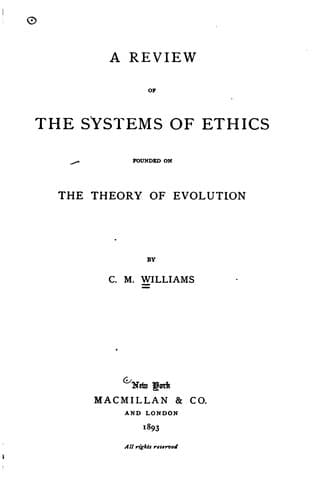
A Review of the Systems of Ethics Founded on the Theory of EvolutionWilliams, Cora May
Philosophy
A Review of the Systems of Ethics Founded on the Theory of Evolution
Williams, Cora May
Ethics, Evolutionary
Three classes of actions to which public opinion applies its sanction
may be distinguished: actions blamed; those the neglect of which is
blamed; and those which are praised. The first two classes, sanctioned
by a punishment, are regarded as duty; the last class, sanctioned by at
least mental reward, are actions of desert. Actions the omission of
which is punished or blamed are not actions of desert, but of duty and
obligation.
The boundary-line between duty and desert is not fixed and definite; in
the measure in which the moral condition of a society is perfected, the
province of that which is regarded as duty is extended into that which
was formerly regarded as desert. The distinction between duty and desert
has, in general, only an outward significance; it has regard to the
relation to others, to the social sanction. The moral human being does
not inquire what entitles him to praise, but simply what is right; and
he does not compare himself with others but with his moral ideal. Hence
he recognizes, with regard to himself, only duty, not desert. He aspires
to attain, not the approbation of others, but his own, and he attains
this only when he has done that which he holds to be the best possible.
The moral significance of the outward sanction lies in its educating
influence; it acts as counterpoise to inclination to action opposed to
the moral law, and facilitates, thus, the victory of the moral motives,
which increase in strength through use. If it is true that a condition
of "heteronomy" always precedes that of "autonomy," then the outer
sanction is the indispensable condition of the evolution of moral
feelings.
It has sometimes been said that the human being is under obligation to
others only. But it seems that this view has proceeded from a confusion
of the moral with the juridic significance of the word "duty." It is not
to be doubted that the consciousness of duty would not develop in an
individual who grew up in solitude,--but speech and reason likewise
would not become his. The law of morality applies not only to social
conduct but also to conduct having reference to self.
By "moral law" is not meant a law in the sense that it is imposed on
human beings from without, by another; it is exactly the peculiarity of
the moral law that it is self-imposed as the voice of conscience.
Virtue is related to duty as the enduring characteristic to the single
action, or the lasting will to obligation, to the "ought"; virtue is a
disposition to act in accordance with duty. Vice is a characteristic
which continually determines actions opposed to duty.
Public-domain text, read in full here on John Shaqi.
Reviews
Reviews
No reviews yet
Be the first to share your thoughts on this work.
Elsewhere in the archive
Join the Discussion
Join the discussion
Sign in to leave a comment or review.
Sign InorCreate an account