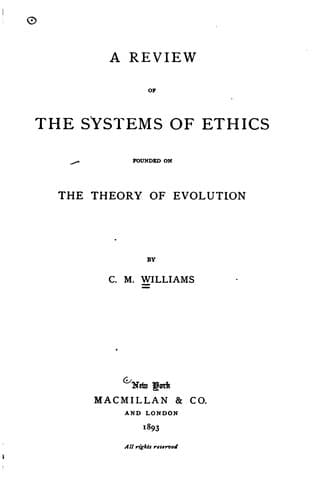
A Review of the Systems of Ethics Founded on the Theory of EvolutionWilliams, Cora May
Philosophy
A Review of the Systems of Ethics Founded on the Theory of Evolution
Williams, Cora May
Ethics, Evolutionary
There may be exceptional cases where vice is innate, as is idiocy or
insanity, but the records of prisons and reformatories where a moral
influence has been attempted, show us that germs of good may exist even
in those apparently wholly given over to vice. It is true that the
capacity for moral education is narrowed with every added year of life;
but it is impossible for us to say, with certainty, how great this
decrease of capacity may be.[79]
The most essential influence for moral betterment is that which the
personality of an earnest human being exerts by example and precept. The
awakening and strengthening of good impulses is not, however, the
immediate destruction of the bad; and struggle is often necessary if the
good shall conquer. The more frequent the victory, the easier it
becomes. Every virtue can be acquired at least in some degree, if the
wish to acquire it be sufficiently strong and persistent.
But although such struggle as this is often necessary, exactly the sign
of the attainment of virtue consists in the absence of self-compulsion;
by this absence, its perfection is measured.
The assertion, occasionally heard, that virtue is in proportion to
struggle, amounts to the contradictory assertion that the more perfect
the man is, the less is his virtue. The truths which, imperfectly
comprehended, lead to this opinion, are these: We distinguish by the
name of virtue that moral constitution which rises above the average. It
is presupposed, however, that its possessor has, in general, the
impulses and capacities belonging to human nature; he could not be
called temperate in any particular direction, if he did not possess the
capacity of enjoyment which leads many to intemperance. Moreover, the
control of strong impulses from a desire to do right presupposes a
strong sense of duty; and it is on account of this sense of duty that we
respect a man. But if an individual distinguished by a strong sense of
duty gradually succeeds in tempering his impulses and ridding himself of
his faults, his virtue is not less, but more perfect. And finally, the
fact is also to be taken into consideration that, while one cannot
necessarily conclude, from a man's innate love for some especial class
of good actions, that he will do his duty in other directions also, this
is an inference which can be drawn where actions are performed from a
sense of duty.
A certain degree of intelligence is a condition of virtue; a being
without reason is not a moral being, as the animal is not; but morality
requires only average human intelligence.
There is no greater error than the opinion that virtue is not concerned
with action; for virtue is excellence of character which leads to right
action; action is the test of moral worth.
In olden times, an attempt was often made to set up one especial form of
character as universal ideal. Such an attempt is injustifiable, since
the nature and circumstances of individuals differ. In morality, too,
there may be originality.
Public-domain text, read in full here on John Shaqi.
Reviews
Reviews
No reviews yet
Be the first to share your thoughts on this work.
Elsewhere in the archive
Join the Discussion
Join the discussion
Sign in to leave a comment or review.
Sign InorCreate an account