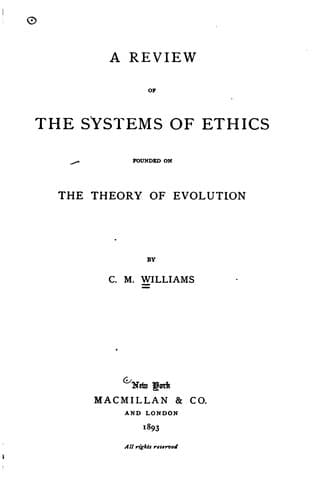
A Review of the Systems of Ethics Founded on the Theory of EvolutionWilliams, Cora May
Philosophy
A Review of the Systems of Ethics Founded on the Theory of Evolution
Williams, Cora May
Ethics, Evolutionary
It has been said that "one should not allow himself to be determined,
but should himself determine his act." This assertion makes self
something distinct from one's thoughts and feelings. Free will has also
been interpreted as choice between motives. The human being does not,
however, choose between motives but between acts, and his choice is free
in that he can, as has been said, choose this or that act _if he will_;
but his choice is not the less caused. When, in reflection on a past
act, the human being says to himself: "It was possible for me to act
otherwise," he means, as a rule, simply: "If I had thought as I do now,
I should not have acted thus; but I did not think as I do now." The
delusion that he might have acted differently under the same outer
circumstances and with the same thoughts and feelings, arises from the
difficulty of realizing, from his present standpoint, his position at
the time of action. It may, indeed, seem to us, after we have chosen a
certain course, that another was the easier; but can it be possible that
one preferred the former course when he yet really preferred the latter?
It is the strongest motive that determines the action. Or, if it be
objected to this assertion, that our only criterion of the strength of
motives is their effect as overcoming other motives, the assertion that
the will follows the strongest motive would still exclude accident in
choice; the assertion would amount to this: that the motive which
determines the will in the one instance will always, under the same
outer and inner circumstances, determine it. So Mill remarks that, when
we say that the heavier weight will weigh down the other, we understand
by "heavier weight," merely the one which will weigh down the other.
Nevertheless, the sentence is not senseless, since it means that there
is, in many or most cases, a heavier weight, and that its action is
always the same. Education by others, and self-education would be
useless, if the same thoughts and feelings could, under the same
circumstances, produce now this, now that totally different result, and
not always the same one.
Public-domain text, read in full here on John Shaqi.
Reviews
Reviews
No reviews yet
Be the first to share your thoughts on this work.
Elsewhere in the archive
Join the Discussion
Join the discussion
Sign in to leave a comment or review.
Sign InorCreate an account