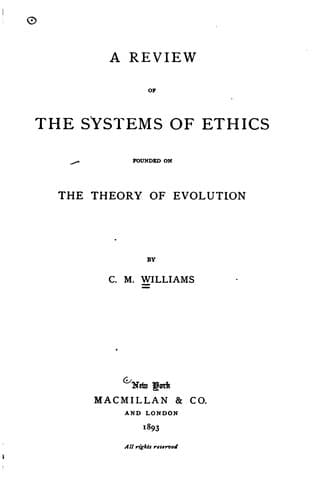
A Review of the Systems of Ethics Founded on the Theory of EvolutionWilliams, Cora May
Philosophy
A Review of the Systems of Ethics Founded on the Theory of Evolution
Williams, Cora May
Ethics, Evolutionary
Those who deny the action of cause and effect in the conduct of men as
contradictory of freedom, cannot refer to physical or political liberty,
since the absence of these does not involve the absence of cause and
effect. The free will which is said to be peculiar to the human being
and not possessed by the animals, is an absence of subjection to the
impressions of the moment, and this has been regarded as an activity of
pure reason. But, as Hoeffding says, the contest of the reason with the
passions is really a contest between feelings combined with reflections
of reason and other violent feelings that are combined with few
thought-elements. This free will is the capacity of reflection gained by
experience. It is not a negation of cause and effect, for the act of the
will is determined by the feelings, thoughts, inclinations, which
precede it; it may be determined by reflection as opposed to the
impressions of the moment. The word "freedom" is also used to denote
moral freedom, or the freedom from determination by immoral motives; in
such case, however, moral motives determine.
But it must be remembered that the natural law of cause and effect is
not like a law in the sense of the political law; it is not something
imposed from the outside. Natural laws are rules formed by men to
express the regularity of events in one sentence; things do not obey the
laws, but the laws are according to things. When we say: Gunpowder
"must" explode when it comes in contact with a flame, the explosion is
necessary; we do not mean that the gunpowder is compelled, under certain
circumstances, to explode; it explodes of its own essential nature.
"Necessity" designates, not a state of things, but a state of the
understanding regarding them. The same is true of the words "possible"
and "accidental." The accidental is the unintentional. The bullet which
accidentally killed a man was not sent with the intention of killing
him. Or "accident" is used of that with regard to which we are ignorant
and cannot predict; the word does not, in this sense either, denote an
absence of cause. Objectively, nothing is "possible"; either it is, or
it is not. Great confusion is, however, caused by a want of clearness in
the interpretation of the words "possible," "impossible," "necessary,"
etc., with regard to the will. When I say: "It is _possible_ for the
good man to perform even the worst action, he _can_ perform it"; and:
"It is not _possible_ for the good man to perform a bad act, he cannot
do it"; I use the words "possible" and "can" in two quite different
senses. The first sentence means: "Even the best man can perform the
worst act _if he will_"; the second: "The good man never has the will;
it follows from his nature that he does not possess it; it would be a
self-contradiction to say that he has it." The human being can do this
or that if he wills, provided no outer force opposes his will; but
whether he wills or not depends upon his character. His will is not
uncaused.
Public-domain text, read in full here on John Shaqi.
Reviews
Reviews
No reviews yet
Be the first to share your thoughts on this work.
Elsewhere in the archive
Join the Discussion
Join the discussion
Sign in to leave a comment or review.
Sign InorCreate an account