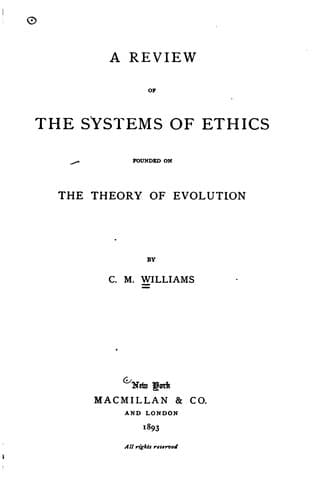
A Review of the Systems of Ethics Founded on the Theory of EvolutionWilliams, Cora May
Philosophy
A Review of the Systems of Ethics Founded on the Theory of Evolution
Williams, Cora May
Ethics, Evolutionary
Accountability assumes that some one is held answerable for an action or
event, and is, as answerable, amenable to punishment. The punishment may
be one of law, of society, or a moral punishment. The concept of
responsibility is closely allied to that of accountability; it assumes,
in general, that a person is the author of a deed. Responsibility may be
immediate, when the author of the deed was also its performer, or
mediate, when the performer was another person.
Remorse is pain at the recognition of the immorality of a past action.
With the pain is often connected the wish that the action had not been
performed. This wish is naturally unreasonable, since it is directed to
the impossible. Yet it is not idle, as Schopenhauer asserts, since it
has an effect upon future action. There is often also an egoistic
regret, or one not called forth especially by the conscience, for a past
action. This may or may not be moral, according as it is or is not in
harmony with the general welfare.
The friends of the theory of chance as regards the will have asserted
that shame, remorse, would be impossible, if the human being recognized
the fact that his act was necessary. They have neglected, however, to
give any reasons for this remarkable assertion. If a man recognizes that
the constitution of his mind was such as to lead unavoidably to vicious
acts, this is the strongest motive for condemnation of his own moral
constitution, for pain at it, and an endeavor to better it. But if the
act had no necessary foundation in his character, if it was merely an
accident that his will chose thus, then, since the act is past and there
is no reason for drawing conclusions from it with regard to future
action, how does it concern him?
Blame and punishment, as well as self-blame, have regard to character
and so to the future. Acts are not blameworthy and punishable if they
have no cause. Punishment is inflicted from two motives: as a
preventive, and as an expression of the felt need of retribution.
Originally, mankind punished from a desire for revenge. This is not the
moral motive. Not the criminal alone, but the whole constitution of
society, is responsible for his crime. If, then, punishment is allowable
for the sake of prevention, it cannot, as an evil, be permissible
further than is in accordance with this end. Punishment of the insane
could be justified only in case it could prevent insanity.
Nor is desert based upon an uncaused character of the will. We do not
admire, praise, and reward great genius the less because genius is
inborn; nor do we admire the moral man the less because his father
before him was distinguished by deeds of philanthropy. We admire him for
what he _is_.
Public-domain text, read in full here on John Shaqi.
Reviews
Reviews
No reviews yet
Be the first to share your thoughts on this work.
Elsewhere in the archive
Join the Discussion
Join the discussion
Sign in to leave a comment or review.
Sign InorCreate an account