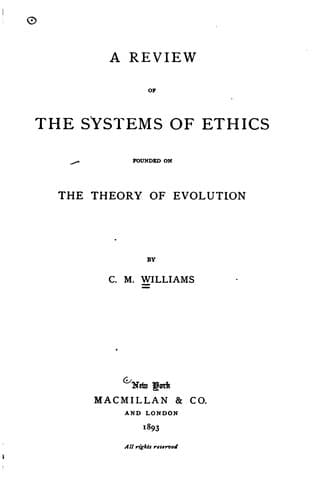
A Review of the Systems of Ethics Founded on the Theory of EvolutionWilliams, Cora May
Philosophy
A Review of the Systems of Ethics Founded on the Theory of Evolution
Williams, Cora May
Ethics, Evolutionary
The doctrine of causality in human action is far from being what it is
sometimes called, a doctrine of fatalism. Fatalism assumes that,
whatever a man may do, a power outside him determines the event; but the
recognition of cause and effect in human action is the recognition of
the fact that the actions of human beings are never without result.
It is often said that morality is founded upon religion. Assuming that,
by religion, is meant the belief in a personal God and in the
immortality of the soul, is this true?
If a mighty tyrant commanded a man to do what was contrary to his
conscience, if he promised rich reward for obedience and fearful torture
for disobedience, would obedience therefore be moral? Why is it
represented as wrong to follow Satan's commands and right to follow
God's will? Evidently not because God is mighty but because he is good,
and Satan is bad. But if it is, thus, a matter of duty, and not merely
one of selfish cunning, to obey God's will, then his will must be
directed to the good; and this presupposes the good to be something in
itself, without regard to the fact that God wills it. If God is a moral
being, this must be so.
This is, in fact, an assumption which the moral members of society have,
in general, made. They boast of the morals of their religion, comparing
it, in this respect, with other religions; and thus they subject it to
the test of morality. Moreover, when we examine the Christian gospel, we
find that it in general assumes the moral laws as already existent and
only urges obedience to them. The good is, as we have seen, that which
conduces to the general welfare. The earliest religions had no
connection with rules of morality; these have developed with the social
life of human beings and have, in it, their root.
As to the belief in immortality, cannot the human being do right without
the thought of the reward and punishment of another life? As a matter of
fact, many good men have not possessed such a belief. The distance of
such an end often makes its effect a weak one, and the motive may easily
become selfish. Yet it is true that a loss of faith may include a loss
of morality, in case the belief exist that there is no basis for
morality outside religion; the responsibility of such a loss of morality
lies with those who teach this latter doctrine. Through love to others
and the thought of the immortality of influence, the moral man gains a
larger life and loses the fear of death. He who has thus faced the
thought of death finds life more earnest but not less happy. Each hour
has not the less its own joy because there is an end, at last. Nor, in
spite of the deep pain the loss of friends causes us, do we lose them
wholly, since the memory of all that was best in them may remain with
us. Our own pain may bring to us a deeper sympathy with, and love for,
others.
Public-domain text, read in full here on John Shaqi.
Reviews
Reviews
No reviews yet
Be the first to share your thoughts on this work.
Elsewhere in the archive
Join the Discussion
Join the discussion
Sign in to leave a comment or review.
Sign InorCreate an account