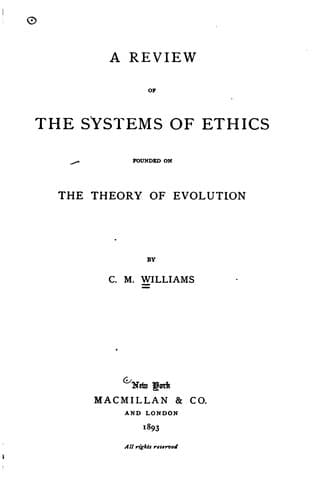
A Review of the Systems of Ethics Founded on the Theory of EvolutionWilliams, Cora May
Philosophy
A Review of the Systems of Ethics Founded on the Theory of Evolution
Williams, Cora May
Ethics, Evolutionary
Nothing is more striking at the present time than the convergence of
different schools of Ethics--English Utilitarianism developing into
Evolutional Ethics, on the one hand, and the idealism associated with
the German philosophy derived from Kant on the other. The convergence is
not, of course, in mere practical precepts, but in method also. It
consists in an "objectivity" or impartiality of treatment, commonly
called "scientific." There is also a convergence in general results
which consists in a recognition of a kind of proportion between
individual and society, expressed by the phrase "organic connection."
The theory of egoism, pure and simple, has been long dead;
Utilitarianism succeeded it and enlarged the moral end. Evolution
continued the process of enlarging the individual interest, and has
given precision to the relation between the individual and the moral
law. But in this it has added nothing new; for Hegel, in the early part
of the century, gave life to Kant's formula by treating the law of
morality as realized in the society and the state. The change in ethical
conception is not due to biological research alone, but to the study of
history also, and to other general changes in the practical data on
which its principles are built. The social and political history of the
century represents the growth of the idea of freedom, which has properly
two sides--that of individual liberty of healthy development, and that
of the solidarity of society and the responsibility of the individual
to it. With the increasing complexity of interests and the growth of
individual freedom, has come, however, a certain sense of loneliness to
the individual in the midst of modern competition, and this explains, to
a great extent, the increase of suicide in the present century.
The convergence of dissimilar theories affords us some prospect of
obtaining a satisfactory statement of the ethical truths towards which
they seem to move.
Our inquiry falls into two parts, according as we analyze the
conceptions which relate to the existence of the moral judgment or those
connected with its growth, maintenance, and change--the statics or the
dynamics of morality. To these two divisions is to be added a third,
preliminary division, more closely allied with the statical examination
of morality. These three parts are represented by the questions: (1)
What is it that is good? To what are the terms good and bad applied? (2)
Why is it good? What does its goodness mean? (3) How does goodness come
into being; how is it maintained; how does it advance?
Public-domain text, read in full here on John Shaqi.
Reviews
Reviews
No reviews yet
Be the first to share your thoughts on this work.
Elsewhere in the archive
Join the Discussion
Join the discussion
Sign in to leave a comment or review.
Sign InorCreate an account