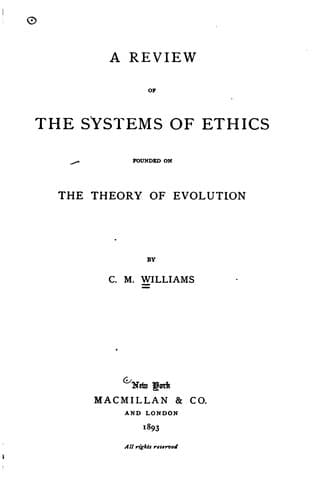
A Review of the Systems of Ethics Founded on the Theory of EvolutionWilliams, Cora May
Philosophy
A Review of the Systems of Ethics Founded on the Theory of Evolution
Williams, Cora May
Ethics, Evolutionary
Natural selection is therefore a power of judgment, in that it preserves
the just and lets the evil perish. Will this war of the good with the
evil always continue? Or will the perfect kingdom of righteousness one
day prevail? We hope this last but we cannot know certainly.
We ourselves shall decide our future, by our acts.
* * * * *
In an essay written for the Society for Ethical Culture, and read
October 10, 1891, before the London branch of that society, Gizycki
reconstructs his theory of the right final end of life, advocating as
such the General Welfare, instead of Peace of Conscience in the pursuit
of the same. The objections to his own former theory offered are,
chiefly, that if peace of conscience is regarded as the final end, the
individual is likely to take too little account of the outward effects
of his action, to be too little impressed by the evil results which
should teach him greater care. The good of society is regarded by the
virtuous man as more important than his own happiness, as that for which
he is willing to sacrifice his own peace.
FOOTNOTES:
[79] The references here are to Lombroso, "Der Verbrecher," deutsche
Ausgabe, S. 129 u. f.; H. v. Valentini, "Das Verbrecherthum im
preussischen Staate," S. 226 u. f.
[80] Intelligibile Ursache.
[81] Grenzbegriff.
S. ALEXANDER
"MORAL ORDER AND PROGRESS" (1889)
The proper business of Ethics is the study of moral judgments--or, if we
say of human conduct, then of conduct as submitted to the praise or
blame of moral judgments. But these judgments are not mere opinions;
conduct is not that which is "judged" to be right in distinction from
that which is right; and thus the analysis of such judgments is a
systematization of both conceptions and facts.
The task of Ethics falls into two parts. It has (1) to supply a
_catalogue raisonne_ of the moral observances of life, the various moral
judgments which make up the contents of the moral consciousness, and (2)
to discuss what it is that the moral judgment, as such, expresses.
Public-domain text, read in full here on John Shaqi.
Reviews
Reviews
No reviews yet
Be the first to share your thoughts on this work.
Elsewhere in the archive
Join the Discussion
Join the discussion
Sign in to leave a comment or review.
Sign InorCreate an account