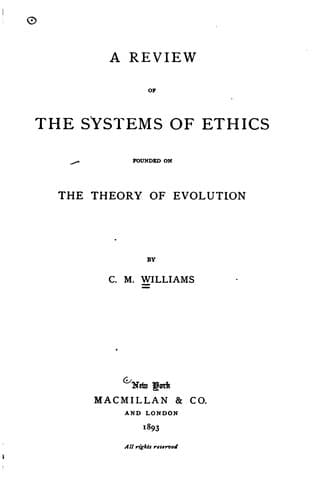
A Review of the Systems of Ethics Founded on the Theory of EvolutionWilliams, Cora May
Philosophy
A Review of the Systems of Ethics Founded on the Theory of Evolution
Williams, Cora May
Ethics, Evolutionary
The internal side of conduct is represented by the moral sentiments.
These are to be distinguished from the mere motives, which, defined as
something that has propulsive force, whether a feeling or a passion,
does not enter into moral action except as absorbed into volition. No
emotion is, in itself, right or wrong, but is only indirectly judged as
such as it makes a difference to the action--as an aptitude of mind
which tends to this or that predominating form of conduct. Moral
sentiments, on the other hand, as moral aptitudes effective for
particular conduct, contain an additional element. Moral sentiments,
thus defined, being equivalent to conduct, it follows that the mere
possession of sentiments cannot constitute the difference between
intrinsic or internal, and customary morality; customs are themselves a
matter of sentiment. Thus "conduct as a concrete whole has an inward
element of sentiment and an outward element of action, and these are
different, on the one hand from mere given feelings, on the other from
mere action." "Conduct is this unity of feeling and action in which mere
feeling is modified by the idea of action, and mere action becomes a
mental, or, if we like, a spiritual thing." "Conduct and character are
the same thing facing different ways." "Think of a man's conduct in
relation to the mental conditions from which it proceeds, and you think
of his character; think of his character as it produces results beyond
these sentiments themselves, and you have conduct."
There are no morally indifferent acts; when viewed in general and
broader lights, all acts are either good or bad; though there are some
cases of really indifferent means arising from the mechanism of action;
as, for instance, that I am to go to London is not indifferent, but we
may suppose that the fact that I may go by the road or by the river
makes no difference to my volition. There is no distinction between
virtue and prudence as regard for self, but prudence, in so far as it is
compatible with social requirements, is a duty and a virtue.
Ethics, then, has to do with conduct as a whole in its external and its
internal aspects. In distinction from Psychology, it has to do with it
not merely as a fact to be analyzed, but with reference to its nature,
quality, or content, judged by a standard of value. It is not dependent
upon Metaphysics, but precedes it in order of time, whatever may be said
of the order of importance; Metaphysics examines, properly, the ultimate
questions left over unanswered by the other sciences. From the purely
physical method, Ethics has advanced to a biological method; and the
doctrine that pleasure is the end of right action has been replaced by
the idea of social vitality as the end.
STATICAL ANALYSIS--MORAL ORDER
Public-domain text, read in full here on John Shaqi.
Reviews
Reviews
No reviews yet
Be the first to share your thoughts on this work.
Elsewhere in the archive
Join the Discussion
Join the discussion
Sign in to leave a comment or review.
Sign InorCreate an account