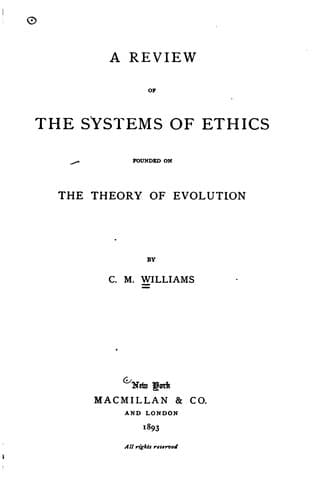
A Review of the Systems of Ethics Founded on the Theory of EvolutionWilliams, Cora May
Philosophy
A Review of the Systems of Ethics Founded on the Theory of Evolution
Williams, Cora May
Ethics, Evolutionary
The recognition of the reference in morality to society has been implied
in all ethical theories; theories of selfish pleasure themselves
recognize the social element in individual gratification, even Cyrenaic
theories recommending selection and refinement of pleasures, and
containing a reference to personal dignity which implies a conception of
man as typical of a perfection that others may sympathize in and attain.
Individualism and Universalism in morals differ only in the order in
which they take their terms. "To the former, the individual comes first
and is the measure of the law; to the latter, the law or society comes
first, and is the measure of the worth of the individual." Nevertheless,
the ethical problem is very differently conceived by the two schools.
But the History of Philosophy shows a tendency to harmonization of the
two; we find that Individualism becomes more and more socialistic, while
Universalism becomes more and more conscious of individuality. We may
trace this movement, in the case of Individualism, in the development of
the philosophic theory of morality as true benevolence from the theory
of benevolence as merely another form of self-love. The earlier
conceptions of Universalism, emphasizing the good as something binding
irrespective of the inclinations of the individual, issue in particular
formulae of virtue; later conceptions recognize the differences of
individual cases while still insisting on the universal or authoritative
character of morality. The problem receives its definite shape when the
explanation of authority is sought, not in some categorical imperative,
but in the very nature of society itself, which, if a whole, is yet a
whole made up of individuals. Ethical inquiry thus naturally breaks up
into two parts, according as we consider the meaning of right and wrong
for the individual, or for society as embracing many individuals.
As far as morality concerns itself with the individual, the good act
implies a certain adjustment of functions to one another, too much in
any one direction implying a defect in others. "The good life as a whole
is a system of consecutive acts, where each function has its limits
prescribed for it by the demands of all the other functions." And the
good character is "an order or systematic arrangement of volitions." The
goodness of an act is thus a matter of equilibration or adjustment of
the elements of an individual's nature. In this proportion or adjustment
consists the reasonableness, rationality (ratio, [Greek: logos]) of good
conduct. This does not mean that the principle of morality is the result
of reason, for moral adjustment is no more specially the work of reason
than of any other mental faculty.
Public-domain text, read in full here on John Shaqi.
Reviews
Reviews
No reviews yet
Be the first to share your thoughts on this work.
Elsewhere in the archive
Join the Discussion
Join the discussion
Sign in to leave a comment or review.
Sign InorCreate an account