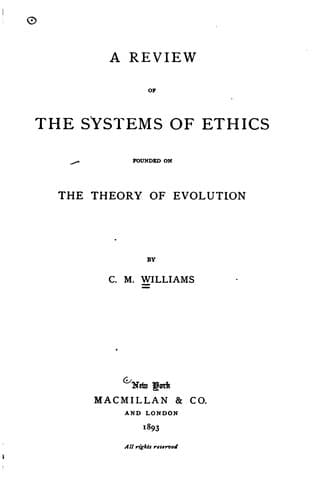
A Review of the Systems of Ethics Founded on the Theory of EvolutionWilliams, Cora May
Philosophy
A Review of the Systems of Ethics Founded on the Theory of Evolution
Williams, Cora May
Ethics, Evolutionary
"If an ultimate ideal were admissible, it would be impossible to assert
that morality is essentially progressive." Morality, in the sense of an
equilibrium, has at every stage a certain finality, in the sense that it
is, for that stage, the ideal adjustment. But we cannot conceive of any
ideal as final in the sense of stationary. The good is always ultimate
but always in motion. "Moral progress admits of only two degrees of
comparison, the superlative being identical with the positive." By
"best" we do not imply a greater rightness in the ultimate condition,
but only a highest development. Spencer's conception of the distinction
between Absolute and Relative Ethics involves the conception of an
ultimate "ideal congruity," or complete adaptation of man to his
conditions, a mobile equilibrium including perfection as well as
goodness, present choice being never between wrong and an absolute
right, but always between two wrongs, the lesser of which is to have the
preference. The picture is, in itself, perfectly legitimate; and in so
far as Spencer "conceives that the only ideal is the absolutely right
conduct, his conception is not only legitimate, but true." There is
always, however, an absolute right that may be chosen; and "using the
conception of a mobile equilibrium, we found it to be, not a goal of
progress, but the meaning of goodness at any time." "The distinction of
good and bad (right and wrong) arises within the limited range of
conditions that are to be met by good action." That, as Sidgwick
asserts, there is always some course of conduct which is right, the
moral consciousness declares with certainty, and is thus against the
relativity of morality. Mr. Spencer holds that any concomitant of pain
makes an action wrong, therefore it is natural for him to regard all
present morality as only relative. But to the good man the pleasure of
doing right exceeds the possible attendant pains of an action; and
except upon the understanding that, in a society of good men, every one
will adjust himself with equanimity to the needs of others, not even the
acts which are declared to be typical of absolutely right conduct can be
free from concomitant pain. "Will the ideal state exhibit no
competitions, such as rivalry in love, which can be ended indeed with
the contentment of all persons, but assuredly not without attendant
pain?"
Public-domain text, read in full here on John Shaqi.
Reviews
Reviews
No reviews yet
Be the first to share your thoughts on this work.
Elsewhere in the archive
Join the Discussion
Join the discussion
Sign in to leave a comment or review.
Sign InorCreate an account