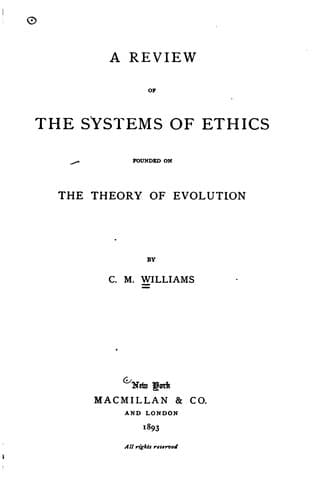
A Review of the Systems of Ethics Founded on the Theory of EvolutionWilliams, Cora May
Philosophy
A Review of the Systems of Ethics Founded on the Theory of Evolution
Williams, Cora May
Ethics, Evolutionary
than when they have been produced by a constant discipline."
It might seem, then, that we could classify duties under virtues. To a
considerable extent such a classification is possible. But it must be
imperfect, because there are duties--for example, filial duty, or the
duty of casting one's vote in a political contest--which do not
correspond to any general head of virtue, or may be ranked under several
heads: and again, we may rank along with virtues which stand for duties
qualities of conduct which do not correspond to duties in the same
sense; as, for instance, in a list of heads of duties, wisdom and
self-control. The enumeration mixes up two classifications, in the one
of which we group observances together under certain heads, in the other
of which we enumerate certain elements of good action in general,
certain aspects which every good action presents, and we exhibit them as
qualities in the agent's mind. The two classifications are combined in
the ancient description of morality under the heads of wisdom, courage,
temperance, and justice. The better classification is by moral
institutions, where the moral life is already mapped out for us into its
different parts. Such a scheme of classification will consider (_a_) the
Individual, (_b_) the Family, (_c_) the Society, (_d_) the State; the
fourth division including international duties, the third not being
necessarily limited to a particular society, but extending to all
mankind.
DYNAMICAL ANALYSIS--MORAL GROWTH AND PROGRESS
The previous description of morality supposes it to be stationary, and
is like a section taken across the path of morality at any one time. It
gives us no idea of the process and progress of morality. We have yet to
show how the moral order is produced, and to examine the meaning and the
law of moral progress.
As the moral organism may be compared to a species of which the various
moral individuals are the members, so the moral ideal may be regarded as
a species of which the various ideals in the minds of good men are the
different individuals. We should thus expect to find the origin and
growth of morality analogous to or, more strictly speaking, identical
with, the growth of natural species.
Public-domain text, read in full here on John Shaqi.
Reviews
Reviews
No reviews yet
Be the first to share your thoughts on this work.
Elsewhere in the archive
Join the Discussion
Join the discussion
Sign in to leave a comment or review.
Sign InorCreate an account