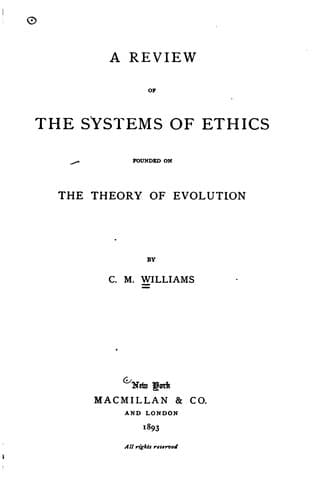
A Review of the Systems of Ethics Founded on the Theory of Evolution — John Shaqi
A Review of the Systems of Ethics Founded on the Theory of EvolutionWilliams, Cora May
Philosophy
A Review of the Systems of Ethics Founded on the Theory of Evolution
Williams, Cora May
Ethics, Evolutionary
"If we are satisfied that force or forces are all that exist in the
material universe, we are next led to inquire what is force." We are
acquainted with two kinds of force--our own will-force, and the forces
of nature. Freedom of the will cannot be disproved, for it cannot be
shown that there is not one-thousandth of a grain's difference between
the force exerted by the body and the force derived from without. "If,
therefore, we have traced one force, however minute, to an origin in our
will, while we have no knowledge of any other primary cause of force, it
does not seem an improbable conclusion that all force may be will-force;
and thus, that the whole universe is not merely dependent on, but
actually _is_ the _will_ of higher intelligences, or of one Supreme
Intelligence."
But though Wallace declares "natural selection, as the law of the
strongest, inadequate" to account for man's mental and moral
development, since the finer feelings and capacities could have been of
no use to human beings in the early stages of barbarism, and further
maintains that it is also difficult to understand how "feelings
developed by one set of actions could be transferred to acts of which
the utility was partial, imaginary, or altogether absent," he
nevertheless has other passages like the following: "In proportion as
physical characteristics become of less importance, mental and moral
qualities will have increasing influence on the well-being of the race.
Capacity for acting in concert for protection and for the acquisition of
food and shelter; sympathy, which leads all in turn to assist each
other; the sense of right, which checks depredations upon our fellows;
the smaller development of the combative and destructive propensities,
self-restraint in present appetites; and that intelligent foresight
which prepares for the future, are all qualities that, from their
earliest appearance, must have been for the benefit of each community,
and would, therefore, have become the subjects of natural selection. For
it is evident that such qualities would be for the well-being of man;
would guard him against external enemies, against internal dissensions,
and against the effects of inclement seasons and impending famine, more
surely than could any merely physical modification. Tribes in which such
mental and moral qualities were predominant would therefore have an
advantage over other tribes in which they were less developed, would
live and maintain their numbers, while the others would decrease and
finally succumb." "From the time, therefore, when the social and
sympathetic feelings came into active operation, and the intellectual
and moral faculties became fairly developed, man would cease to be
influenced by natural selection in his physical form and structure. As
an animal, he would remain almost stationary, the changes of the
surrounding universe ceasing to produce in him that powerful modifying
effect which they exercise over other parts of the organic world. But
Public-domain text, read in full here on John Shaqi.
Reviews
Reviews
No reviews yet
Be the first to share your thoughts on this work.
Join the Discussion
Join the discussion
Sign in to leave a comment or review.
Sign InorCreate an account