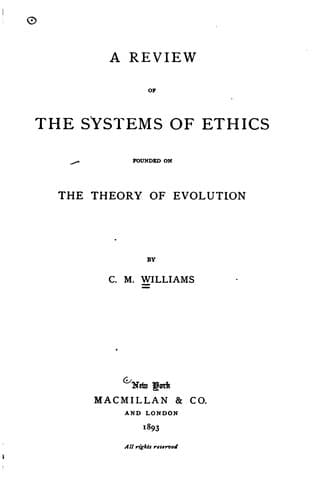
A Review of the Systems of Ethics Founded on the Theory of EvolutionWilliams, Cora May
Philosophy
A Review of the Systems of Ethics Founded on the Theory of Evolution
Williams, Cora May
Ethics, Evolutionary
"In this process we see exhibited the interplay of the element of
goodness or rightness with that of perfection. In all actual goodness,
we have perfection attained as well; but in the statical notion of
goodness perfection is subordinate--only that exercise is perfect which
is legitimate. But in the notion of progressive goodness, perfection
regains its rights. For goodness, having secured perfection, creates new
materials which destroy the old equilibrium and call for a new one.
Goodness determines perfection, but change in perfection determines,
therefore, changes in goodness." Morality is the creation of a better;
this better is change from a lower to a higher development, not the
growth of a greater rightness. All good conduct is _absolutely_ good,
and the good man of former days was as good as the good man of to-day,
although he performed acts not allowable by the higher moral standard
attained as highest development. Accordingly, there is no such thing as
an absolute morality, in comparison with which other conduct is variable
and relative. The relativity of good conduct, instead of being a
reproach, is in reality its highest praise, for it implies that the
conduct takes account of exactly those conditions to which it is meant
to apply. This conception of morality as absolute runs into that of
morality as an eternal and identical law: eternal, for the morality of
given conditions remains eternally true for those conditions; identical,
for although it cannot be called identical in the sense that virtues do
not change with institutions, it is identical in form,--as an
equilibrium of social forces in an order of conduct. The more important
conception of the moral law is its unity in which, as the stages of one
continuous law, its identity consists. "Progress is not mere destruction
of the lower, but fulfilment."
In considering how morality arises, it would be erroneous to suppose
that it comes into existence by an actual compromise. It arises through
a process of continuous change, parts of which may be an insensible
growth, parts the self-conscious adoption of a proposed new scheme. In
the latter case, a slight reform may be adopted with but little
opposition from members of the society other than the proposer, as
meeting a recognized, common want; or, in the case of a more extended
reform, the idea as first proposed may be long contended against, and
only finally adopted after much alteration by reason of contact with
such opposition. In its acceptance innumerable forces are combined,
innumerable different motives determine its acceptation by different
persons. Whatever the motive, however, the conduct of the person
accepting it alters in accordance with its acceptation.
Public-domain text, read in full here on John Shaqi.
Reviews
Reviews
No reviews yet
Be the first to share your thoughts on this work.
Elsewhere in the archive
Join the Discussion
Join the discussion
Sign in to leave a comment or review.
Sign InorCreate an account