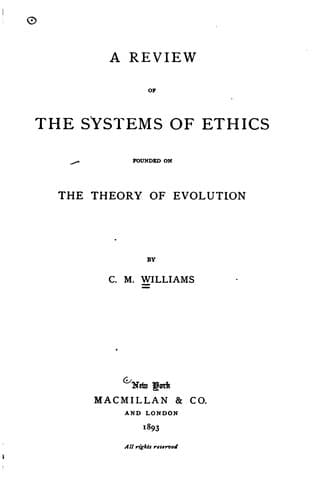
A Review of the Systems of Ethics Founded on the Theory of EvolutionWilliams, Cora May
Philosophy
A Review of the Systems of Ethics Founded on the Theory of Evolution
Williams, Cora May
Ethics, Evolutionary
The chief importance of pleasure and pain lies in the part they take in
such choice. They are "the tests of the act being suitable or the
reverse to the character (in the widest sense) of the agent." If a
reform does not suit the character, it will cause pain and urge to
removal of the pain by resistance; and on the other hand, when the
reform is accepted, it must be that it gives pleasure to the persons
concerned. But in saying this we have to remember the distinction
between ethical (or effective) and pathological (or incidental)
pleasures and pains. The total reaction of character on a stimulus may
be pleasurable, but this pleasure results from a mixture of pleasures
and pains weighed against one another. This balancing of pleasures and
pains is not reflective, but takes place by a kind of intuitive act in
which only subsequent reflection may be able to distinguish the
elements. The pleasure or pain involved in acceptance or rejection is
not the ground of acceptance or rejection. The cause of the acceptance
or rejection is the nature of the reform itself, its congruity or
incongruity with the natures of the persons accepting or rejecting it.
"When the new ideal is definitely established, those who do not obey it
are bad, those who do are good." Those who were good under the old may
thus be bad under the new ideal, and _vice versa_.
The gradual reform through the choice of individuals who act upon their
feelings without knowing the whole aim or bearing of their conduct is
similar to that where a definite reform is the end in view. It is a
gradual adjustment of wills under new conditions and represents the
position of equilibrium which would be completely realized if all the
society were good.
The new ideal is not to be defined as merely the will of the majority,
the possession of a majority being nothing but the fact of its
prevalence. The ground of prevalence is that it represents the
equilibrium. "There is no virtue in mere preponderance; it is not that
reforms follow the majority, but that a majority is attracted by a
suitable reform."
A new ideal arises by a struggle of varieties analogous to that in the
organic world,--the word "struggle" being metaphorical in both cases,
since actual conflict is not necessary to either. "The distinction of
good and bad corresponds to the domination of one variety... which has
come to prevail in virtue of its being a social equilibrium," and thus
representing suitability to all the conditions of life. Evil is simply
that which has been rejected and defeated in the struggle with the good.
Public-domain text, read in full here on John Shaqi.
Reviews
Reviews
No reviews yet
Be the first to share your thoughts on this work.
Elsewhere in the archive
Join the Discussion
Join the discussion
Sign in to leave a comment or review.
Sign InorCreate an account