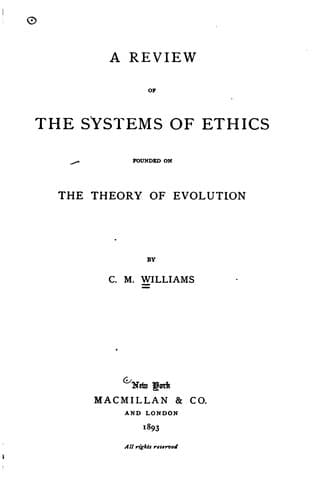
A Review of the Systems of Ethics Founded on the Theory of EvolutionWilliams, Cora May
Philosophy
A Review of the Systems of Ethics Founded on the Theory of Evolution
Williams, Cora May
Ethics, Evolutionary
There are two ways in which the moral ideal is maintained,--by education
and by punishment. Punishment is the condemnation of wrong-doing by
censure or by legal penalties. The unpleasant consequences of neglect of
the self-regarding virtues are not punishment; but the reaction of the
good forces of society against wrong-doing is as natural as the
unpleasant physical effects of imprudence.
"If the question as to what moral sanction is means, 'What reason is
there why morality exists?' the answer lies not in enumerating the
penalties of wrong-doing, but in tracing the origin of morality as an
equilibrium of the forces of society.... But the question, 'Why should I
be moral?' means, most naturally and usually, What inducements are there
to me to do right?" The answer is that motives differ for different
individuals. With some, outer social inducements, with others, the
approbation and disapprobation of conscience are stronger. These latter
ethical pains and pleasures which are felt at the idea of an action
stand on a different footing from feelings having regard to external
rewards and punishments and also the prospective pleasures and pains of
conscience. The man who does right because he shrinks from prospective
pains of conscience is not a good man, but intermediate morally between
the bad man who seeks only to escape legal punishment and the good man
whose pains of conscience felt at the idea of a wrong act prevent his
performing it.
Punishment wears different shapes according to the point of view from
which it is regarded, but, in the distinctively moral view, is
reformatory. All punishment is retribution, but not in the sense that it
is personal vengeance. The value of this idea of retribution lies in the
fact that it places punishment on a line with the process of
self-assertion by which species maintain their life; it is a part of the
reaction of the organism against anything which impedes its vitality.
If, however, punishment avenges the evil deed, it is a confusion to say
that it is for the sake of vengeance. The purpose in the mind of those
punishing is not necessarily vengeance, and the idea of mere retribution
is repugnant to the good man. From the juridic point of view, the object
of punishment is prevention; from the moral point of view, reformation.
The reformation seeks to destroy a bad ideal, and does not necessarily
destroy the individual in whom it is found; but in some cases the
wrong-doer's mind is so perverted that only death, it is judged, will
suffice. "Here, too, paradoxical as it may seem, though perhaps the
chief object of our punishment is the indirect one of bettering others,
we punish with death in order to make him a good man and to bring him
within the ideal of society.... The penalty of death is thought
necessary to bring home to him the enormity of his guilt."
Public-domain text, read in full here on John Shaqi.
Reviews
Reviews
No reviews yet
Be the first to share your thoughts on this work.
Elsewhere in the archive
Join the Discussion
Join the discussion
Sign in to leave a comment or review.
Sign InorCreate an account