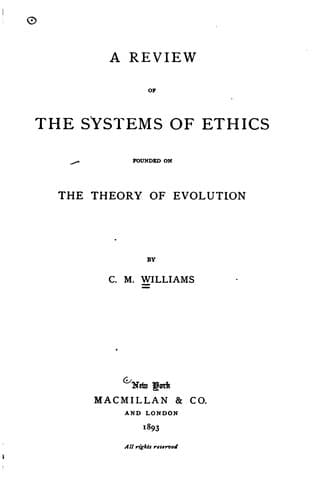
A Review of the Systems of Ethics Founded on the Theory of EvolutionWilliams, Cora May
Philosophy
A Review of the Systems of Ethics Founded on the Theory of Evolution
Williams, Cora May
Ethics, Evolutionary
The object of punishment is not always achieved, but this matters not
for its moral character, which lies in its conscious object. The idea of
punishment as reconciling the criminal with society includes the aspect
of retribution or expiation, under which punishment may be viewed from
without; but it is only when the suffering is attended by reformation
that it can be considered in a proper sense expiation or atonement.
Responsibility differs from obligation by introduction of the element of
punishment. Obligation is the necessity of good conduct which arises out
of the relation of the act to the order of which it forms a part.
"Responsibility is the negative aspect of this relation. When I think of
conduct as required of me, I think of it as my duty; when I think of it
as conduct which if I do not perform, I shall be rightly punished, I
have the sense of responsibility." The sense of responsibility is thus a
knowledge of the requirements of the law, and it is only as we have
law-abiding instincts that we feel it; and we feel it differently
according as we think of the authority of the law as derived from its
mere enactment or as founded upon the social good, or as established in
our own conscience and self-respect, which represent the social good. As
including recognition of certain conduct as right, the sense of
responsibility is more than the mere knowledge and fear of punishment.
"It is only those who can appreciate that punishment will be deserved to
whom the idea of responsibility applies. There is, therefore, no
difference between the fact of responsibility and the sense of
responsibility, any more than there is between goodness and the feeling
of approbation, or duty and the sense of duty. When we declare a bad
man responsible, we mean that the good man holds him to be justly
punished."
Responsibility depends, then, on two things,--that a man is capable of
being influenced by what is right, and that whatever he does is
determined by his character. This capacity depends on his being aware of
the meaning of his acts, and so of their connection with other acts, and
contains thus an element not present in the relations of animals.
Public-domain text, read in full here on John Shaqi.
Reviews
Reviews
No reviews yet
Be the first to share your thoughts on this work.
Elsewhere in the archive
Join the Discussion
Join the discussion
Sign in to leave a comment or review.
Sign InorCreate an account