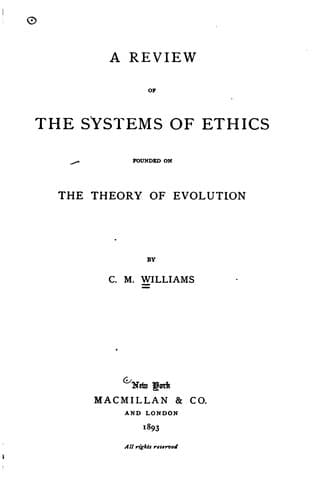
A Review of the Systems of Ethics Founded on the Theory of EvolutionWilliams, Cora May
Philosophy
A Review of the Systems of Ethics Founded on the Theory of Evolution
Williams, Cora May
Ethics, Evolutionary
The test of higher organization usually given is that of increasing
differentiation of parts with corresponding specialization of function.
But the main course of progress is not linear, or in one continuous
direction; apparent reversions to former types are only apparent; the
new type stands higher than the old. In other words, history moves in
cycles. It follows, from this, that mere differentiation is insufficient
for definition. While the differentiation advances, its significance
alters, or, let us say, the relative places of specialization and of
unity alter. Along with differentiation goes a process of integration.
Great revolutions simplify. The result of greater and greater
heterogeneity is to produce a new principle, which combines the warring
elements. The definition of progress by increased differentiation is
lacking in two ways: It tells us nothing of the forces by which progress
is produced, and it gives no connected view of the actual facts of
historical development. A general statement of progress in its formal
sense is found in the conception of a struggle of ideals. But as in this
struggle the survival of the fittest does not necessarily mean the
destruction of those who represented the defeated ideal, but the
supplanting of their ideal by another, the movement is one of
comprehension, and we should expect to find, and do find, the history of
morality exhibit the gradual development of a universal moral order,
good not for one group of men but for all. It would be a misapprehension
to regard this change as merely quantitative, as if the virtues were the
same whether they applied on a larger or a smaller scale. "The
quantitative extension is parallel with, and in reality proceeds from, a
change in the conception of the human person himself." In primitive
communities, the individual is so limited that he can hardly be called
an individual at all. First among the Greeks do we find the person the
embodiment of the social order, but in a limited sense. "When this
limitation breaks down, and the individual stands forth as independent
and self-conscious, the author of the laws he obeys, we have at the same
time the extension of the area of persons with whom he is in moral
relation."
"It matters little that the Western ideal of a society of humanity is
realized to so slight an extent. The ideal exists and implies the
inclusion of mankind." The principle of democracy, which we are engaged
in working out, "continues, or perhaps supersedes, under much more
complex conditions and over a wider range of institutions, the same
principle as Christianity introduced." It is not merely an identical
element in many individual states, but a comprehensive ideal. The power
of naturalization, extradition laws, international action among the
working classes, etc., imply this.
Public-domain text, read in full here on John Shaqi.
Reviews
Reviews
No reviews yet
Be the first to share your thoughts on this work.
Elsewhere in the archive
Join the Discussion
Join the discussion
Sign in to leave a comment or review.
Sign InorCreate an account