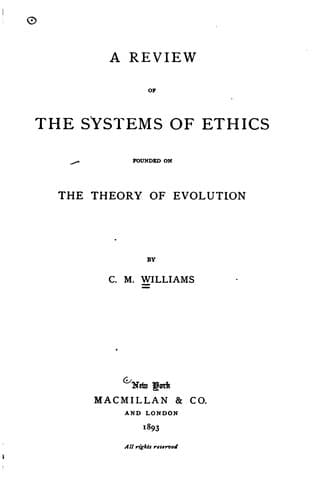
A Review of the Systems of Ethics Founded on the Theory of EvolutionWilliams, Cora May
Philosophy
A Review of the Systems of Ethics Founded on the Theory of Evolution
Williams, Cora May
Ethics, Evolutionary
advantage of type, in which the individual is partaker. So a good
society under simpler conditions is on the side of progress, though it
may lie outside the main line of advance.
It is true that bad persons often help on progress, but the good they do
lies in their representation of the will of society for progress, the
evil lies in their use of this will as means to their own ends. It may
be objected, too, that the good man is sometimes a hindrance to progress
through stupidity; but to this is to be answered that intellect itself
becomes morally characterized in action.
All events and institutions are thus determined by their conditions; but
there is a movement forward distinguishable from the delay of stragglers
and the resistance of enemies, and this distinction is enforced by the
moral predicates of good and bad.
Our theory does not imply that whatever is, is right; such a statement
involves the use of the word right in the sense of "correct," or
"intelligible," "accountable by reflection." Nor is the doctrine
fatalistic. Fatalism implies that men act at the impulse of some force
which they do not understand; "but the history of mankind is the history
of beings who, through their own gift of consciousness, subdue
circumstances to their own characters." In judging a nation's
development, we must not interpret it according to our own likings, as
progression or retrogression; nor must we imagine retrogression from
relaxation of duties in some certain directions, but must regard the
society and its institutions as a whole.
Public-domain text, read in full here on John Shaqi.
Reviews
Reviews
No reviews yet
Be the first to share your thoughts on this work.
Elsewhere in the archive
Join the Discussion
Join the discussion
Sign in to leave a comment or review.
Sign InorCreate an account