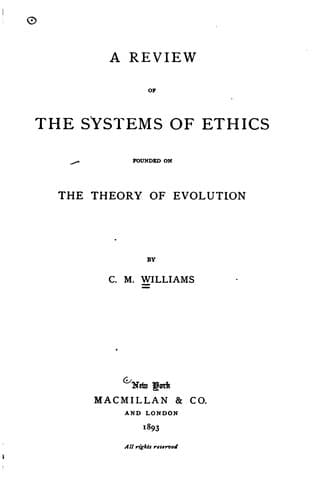
A Review of the Systems of Ethics Founded on the Theory of EvolutionWilliams, Cora May
Philosophy
A Review of the Systems of Ethics Founded on the Theory of Evolution
Williams, Cora May
Ethics, Evolutionary
any ground for supposing that he would have chosen the one rather than
any other method of creation. The internal as well as the external
difficulties in the way of a too literal exegesis of the Old Testament
are rapidly causing the abandonment of dogmatism with respect to this
point; and any other interpretation than a literal one cannot, as has
been said, logically object to a theory of Becoming based on scientific
grounds.
It is in the nature of many of our greatest scientific theories that
their simplicity and naturalness in the explanation of facts fill us
with a sense of wonder that they had not long before suggested
themselves to scientists. If, for instance, we were to attempt, in a
Cartesian spirit, to free ourselves from all the prejudice of previous
dogma and regard only the general course of nature, we could not
logically avoid the conclusion, even from a superficial view, that a
theory of the gradual development of existing forms has far more
probability on its side than that of a creation from without which broke
in upon natural process, and placed ready-made suns and planets in the
heavens, and finished beasts and men upon the earth. Everywhere in the
organic world we behold the process of growth, the development of
germs, the passage of the inorganic into the organic, and of the organic
into the inorganic again,--change and transformation under natural law.
The difficulty which difference of form and function in the various
species offers to a theory of Evolution is by no means so large as has
often been claimed; as great difference exists between the oak and the
acorn, from which we know it, nevertheless, to spring; as much contrast
is exhibited between the brown twigs of the trees and shrubs in winter
and the brilliant foliage and flowers which they put forth under the
warmer sun of spring; quite as great contrasts may be found, in the life
of every human being, between the single cell and the individual
completeness attained at birth, between infancy and morally
characterized manhood and womanhood, between the vigor of full maturity
and the deterioration of age. Even the chasm between the organic and the
inorganic is not logically impassable. The necessity of nourishment is
the natural bridge between the two, and the equivalence of conditions
and result, the indestructibility of matter and motion, establish at
once the necessity of the inference that the organic can exist only at
the ultimate expense of the inorganic, from which it is continually
renewed. Were our senses such that, having before been closed, they were
suddenly opened to the perception of the daily observable facts of
growth, these would probably appear to us very nearly as strange,
anomalous, and impossible as the changes which, according to the
Darwinian Theory, have resulted in the existence of different species;
and it is obvious that the public mind, becoming gradually accustomed to
the conception of the latter changes, does not now regard them as so
Public-domain text, read in full here on John Shaqi.
Reviews
Reviews
No reviews yet
Be the first to share your thoughts on this work.
Elsewhere in the archive
Join the Discussion
Join the discussion
Sign in to leave a comment or review.
Sign InorCreate an account