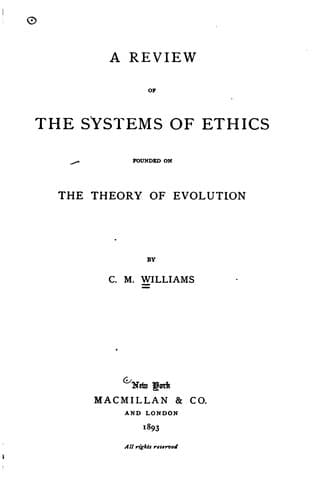
A Review of the Systems of Ethics Founded on the Theory of EvolutionWilliams, Cora May
Philosophy
A Review of the Systems of Ethics Founded on the Theory of Evolution
Williams, Cora May
Ethics, Evolutionary
wonderful and anomalous as they appeared to it in the beginning.
Processes involving complete change of form may be observed, at the
present time, everywhere in nature; but they are observable, everywhere
in the organic, as growth without breaches; even a primitive science has
always recognized the gradual character of motion, the absence of gaps
in the causal chain, at least outside of the initiative action of human
will. Such a natural hypothesis of creation as we have above supposed,
formed upon crude and superficial, but as far as it goes, logical
reasoning from facts of observation, could not regard the process as
other than a gradual one, in which simpler forms and conditions must be
supposed to have preceded more complex ones; in other words, it could
not logically conceive the process as other than an evolution.
Traces of an idea of Evolution may be found in various crude forms in
nearly all the earlier Greek philosophers, especially in Anaximander,
Heraclitus, Democritus, Empedocles, and later in Aristotle. Such traces
may even be found in many heathen mythologies in contradistinction from
the Judaic. The progress of investigation, establishing the universality
of natural law and, in every province, the gradual character of change
was, before Darwin, as it has been since his work, in the direction of
such a theory, as was shown by the ready acceptance with which Darwinism
met, if not by the world at large, at least by the majority of
scientists. In England, France, and Germany, there were others at work
under the influence of thoughts similar to if not identical with those
that inspired the researches and experiments of Darwin; and the nebular
theory of Kant had already claimed in Astronomy what the Darwinian
claimed in Biology. "When Kant, in his Natural History of the Heavens,
which has become the fundament of modern Astronomy, says, 'Give me
matter and I will make you a world,' what he intended to express was
that the natural laws of matter are perfectly competent to render
comprehensible to us the development of our well-known solar
system."[94]
Public-domain text, read in full here on John Shaqi.
Reviews
Reviews
No reviews yet
Be the first to share your thoughts on this work.
Elsewhere in the archive
Join the Discussion
Join the discussion
Sign in to leave a comment or review.
Sign InorCreate an account