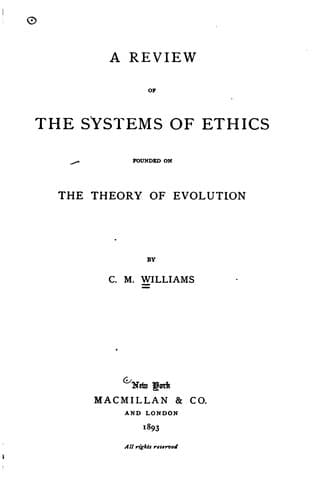
A Review of the Systems of Ethics Founded on the Theory of EvolutionWilliams, Cora May
Philosophy
A Review of the Systems of Ethics Founded on the Theory of Evolution
Williams, Cora May
Ethics, Evolutionary
The preceding considerations have made it evident that the idea of
Evolution has undergone a broadening process since Darwin first brought
it before the world. It is necessary to glance briefly at some of the
chief phases and the general significance of this process in order to
define the extent and intent of the concept as far as science has made
such definition possible.
To Darwin himself the struggle for existence was always between the
unities represented by complete organisms whether as isolated
individuals, or in family, tribal, or national groups. Everywhere in his
calculations, appearing unchanged in his results, is found the unknown
quantity of variation from ancestral type, the known factors being
heredity, and natural and sexual selection in the struggle for
existence. Wallace's ideas as to color in birds deprive the theory of
sexual selection of one of its most important points of application in
Darwin's work. It is, in fact, easy to see that sexual selection cannot
neutralize natural selection, that any particular form of sexual
selection can arise and finally survive only by a harmony with the
direction of natural selection, and that the two must therefore appear,
even from any standpoint of freedom of the will, as continually
attaining coincidence. It has been said, above, that the struggle for
existence was, for Darwin, between the organisms as unities. This
consistent position of the specialist has been criticised, from a more
general point of view, by Lewes in his essay on the Nature of Life,[96]
in which he asserts that we must logically "extend our conception of the
struggle for existence beyond that of the competition and antagonism of
organisms--the external struggle; and include under it the competition
and antagonism of tissues and organs--the internal struggle." "Mr.
Darwin," he says, "has so patiently and profoundly meditated on the
whole subject, that we must be very slow in presuming him to have
overlooked any important point. I know that he has not altogether
overlooked this which we are now considering; but he is so preoccupied
with the tracing out of his splendid discovery in all its bearings, that
he has thrown the emphasis mainly on the external struggle, neglecting
the internal struggle; and has thus, in many passages, employed language
which implies a radical distinction where--as I conceive--no such
distinction can be recognized. 'Natural Selection,' he says, 'depends on
the survival, under various and complex circumstances, of the
best-fitted individuals, but has no relation whatever to the primary
cause of any modification of structure.'[97] On this we may remark,
first, that selection does not _depend_ on the survival, but _is_ that
survival; secondly, that the best-fitted individual survives because of
that modification of its structure which has given it the superiority;
therefore, if the primary cause of this modification is not due to
selection, the selection cannot be the cause of species.
Public-domain text, read in full here on John Shaqi.
Reviews
Reviews
No reviews yet
Be the first to share your thoughts on this work.
Elsewhere in the archive
Join the Discussion
Join the discussion
Sign in to leave a comment or review.
Sign InorCreate an account