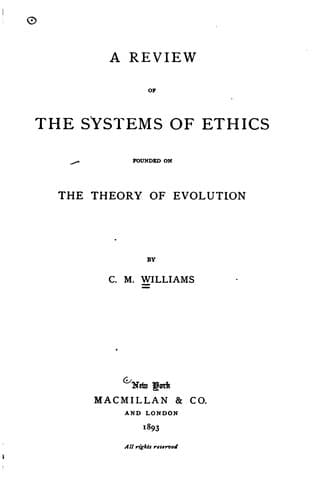
A Review of the Systems of Ethics Founded on the Theory of EvolutionWilliams, Cora May
Philosophy
A Review of the Systems of Ethics Founded on the Theory of Evolution
Williams, Cora May
Ethics, Evolutionary
arise if we regard it as "evolved")--then whence come these increments?
If they come direct from a Creator, then surely no special favor towards
man in the bestowment of soul can be alleged; and if they arise by
natural causes, out of nature, then why may not their first beginning,
their first infinitesimal appearance, also be supposed to be due to such
causes?
The proof of an increase, a growth, of what have been called
distinctively the mental faculties, throughout the animal kingdom, is
every day stronger. No one believes, at the present date, with
Descartes, that the animals are automata. Differences of mental power
would seem to be but differences of degree; the facts all point to such
a theory. The more scientific theologians have, indeed, abandoned this
with the other minor points of contest above discussed, and devoted
their efforts to argument from the moral nature of man. Philology,
Anthropology, and Geology testify to mental progress, even in the human
species; and if such a progress is a fact, it cannot have been without
influence upon the moral nature of man, even supposing the latter to be
God-given. Indeed, a merely physical progress or change cannot have been
without such influence; for the most conservative theologians admit the
strong action of the body upon the mind. It would seem, then, for all
reasons, that an investigation of the process of mental evolution, or of
evolution in general, ought not to be without results significant for
any system of morality. If it is true that we learn wisdom and morality
from human history, this can be so only because history gives us
increased knowledge of the constancy of nature in those of its
manifestations which specially concern the human, and thus enables us
better to judge the present and predict the future. We should suppose
that a still wider knowledge of our mental and physical evolution must
be of yet greater worth to us in the same manner,--that the disclosure
of more extended fields of nature to our vision must afford us new and
valuable lessons with regard to ourselves; just as the telescope makes
no discovery in the most distant regions of space that does not prove to
have, in the end, its peculiar significance for our own planet. If our
investigations should prove fruitless, as all such investigations have
been said by some to be, the fact, established _a posteriori_, could not
be disputed. But, considering all the points above noticed, such a
result could not but astonish us; and we should even be inclined, after
all that has been said, to suspect that the fault lay rather in the
particular method than in the direction of our research.
FOOTNOTES:
[87] "Natuerliche Schoepfungsgeschichte," 8th ed., p. 109.
[88] "Origin of Civilization," p. 391.
[89] "Origin of Civilization."
[90] Ibid.
[91] Ibid.
[92] Ibid.
[93] Ibid.
[94] Du Prel: "Die Entwicklungsgeschichte des Weltalls."
[95] "Die Entwicklungsgeschichte des Weltalls."
CHAPTER I
THE CONCEPTS OF EVOLUTION
Public-domain text, read in full here on John Shaqi.
Reviews
Reviews
No reviews yet
Be the first to share your thoughts on this work.
Elsewhere in the archive
Join the Discussion
Join the discussion
Sign in to leave a comment or review.
Sign InorCreate an account