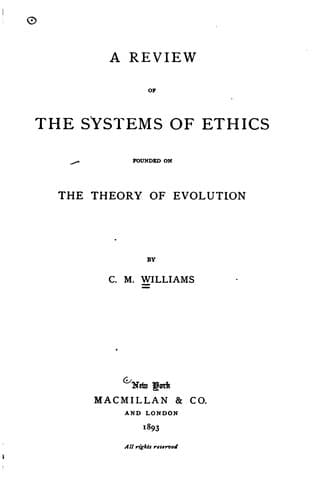
A Review of the Systems of Ethics Founded on the Theory of EvolutionWilliams, Cora May
Philosophy
A Review of the Systems of Ethics Founded on the Theory of Evolution
Williams, Cora May
Ethics, Evolutionary
the individual differences between organic beings in a state of nature,
as shown by every wild animal knowing its mate; and when we reflect on
the infinite diversity of many varieties of our domesticated
productions, we may well be inclined to exclaim, though falsely, as I
believe, that variability must be looked at as an ultimate fact,
necessarily contingent on reproduction. Those authors who adopt this
latter view would probably deny that each separate variation has its own
proper exciting cause. Although we can seldom trace the precise relation
between cause and effect, yet the considerations presently to be given
lead to the conclusion that each modification must have its own distinct
cause." It is "probable that variability of every kind is directly or
indirectly caused by changed conditions of life. Or, to put the case
under another point of view, if it were possible to expose all the
individuals of a species during many generations to absolutely uniform
conditions of life, there would be no variability.... The causes which
induce variability act on the mature organism, on the embryo, and, as we
have good reason to believe, on both sexual elements before impregnation
has been effected." Darwin further considers, in this same book, some of
the probable particular causes of variation, as given in climate and
food. And it may be remarked, in this connection, that Rolph's criticism
of the impossibility of progress under conditions of want is irrelevant
as applied to Darwin, since the latter himself says expressly: "Of all
causes which induce variability, excess of food, whether or not changed
in nature, is probably the most powerful";[99] again: "We have reason to
suspect that an habitual excess of highly nutritive food, or an excess
relatively to the wear and tear of the organization from exercise, is a
powerful exciting cause of variability."[100] Rolph's criticism is
probably due to forgetfulness of the fact that Darwin limited the
struggle for existence to that of complete organisms with one another,
and that, under such a limitation of the conception to external
struggle, a condition of want cannot be conceived as necessarily
precluding a monopoly of abundance by best-fitted individuals.
Theories with regard to the special outer causes and resulting
physiological conditions of variation have been gradually added to, as
facts on this score have accumulated. But, as investigation advances,
the question is seen to involve all the problems of the intricate
chemical and mechanical nature of physiological structure in its
manifold forms and degrees of organization. The field stretches out in
this direction, under our contemplation, to an indefinite distance; and
science appears as yet to have passed only the outer limits of its
territory.
Public-domain text, read in full here on John Shaqi.
Reviews
Reviews
No reviews yet
Be the first to share your thoughts on this work.
Elsewhere in the archive
Join the Discussion
Join the discussion
Sign in to leave a comment or review.
Sign InorCreate an account