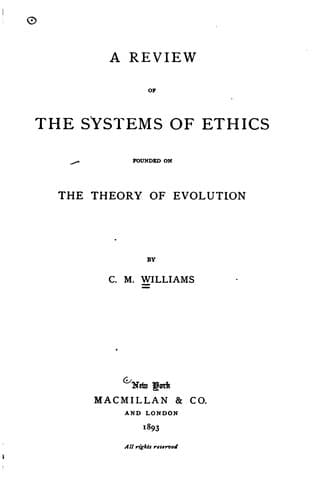
A Review of the Systems of Ethics Founded on the Theory of EvolutionWilliams, Cora May
Philosophy
A Review of the Systems of Ethics Founded on the Theory of Evolution
Williams, Cora May
Ethics, Evolutionary
It is certain that the comparatively recent science of Physiological
Chemistry will have many of the decisive words to say on this score, in
the future. "When we see the symmetrical and complex outgrowths caused
by a single atom of the poison of a gall-insect, we may believe that
slight changes in the chemical nature of the sap or blood would lead to
extraordinary modifications of structure," says the great seer of
evolution himself.[101]
Among special theories of Evolution, a distinction may be made between:
(1) such special theories as aim at biological simplification by
reduction of all organic variation to one primary form of cellular
process; (2) such theories as are content with less ultimate laws, by
which the various ascertained forms of change are included in one
general statement not involving special physiological or physical theory
but applicable to all forms of life; (3) such theories as aim to give
distinctive philosophic expression to a generalization like the last
named, including in this statement both psychical and physiological
phenomena; and (4) such theories as aim at an ultimate expression of the
direction of evolution that shall include the phenomena of life, both
physiological and psychical, under one head with all other natural
phenomena. To the first class belong only "provisional" hypotheses,
among the best known of which are those of Pangenesis, Perigenesis, and
the Continuity of the Germ-Plasm. To the second, which are not merely
tentative but have a broad foundation in known fact, belongs Haeckel's
theory of Inheritance and Adaptation, a theory restated in substance,
from independent research, by Eimer, whose ultimate general factors of
analysis are the same with Haeckel's, though he deals, beyond these,
with special facts and special theories of his own. Phases of the second
class often entitle them to inclusion in the third. An example of the
third class is found in Spencer's definition, "Life is the continual
adjustment of inner relations to outer relations." The fourth and last
class includes Fechner's "Tendency to Stability" and Spencer's theory of
the rhythm of motion (see his "First Principles"), similar to which are
certain ideas of Zoellner, Du Prel, and others; and similar elements to
which are to be found in Haeckel's "Plastidule-Theory." In connection
with this class, reference may be made to an article by Dr. J. Petzoldt
in the "Vierteljahrschrift fuer wissenschaftliche Philosophie" under the
title "Maxima, Minima, und Oekonomie," in which, among others, Fechner's
views especially are discussed with reference to an ultimate principle
of evolution. The first pages on the "Tendency to Stability" in
Fechner's "Ideas concerning the Evolution of the Organic" ("Einige Ideen
zur Schoepfungs- und Entwicklungsgeschichte der Organismen") are as
follows:--
Public-domain text, read in full here on John Shaqi.
Reviews
Reviews
No reviews yet
Be the first to share your thoughts on this work.
Elsewhere in the archive
Join the Discussion
Join the discussion
Sign in to leave a comment or review.
Sign InorCreate an account