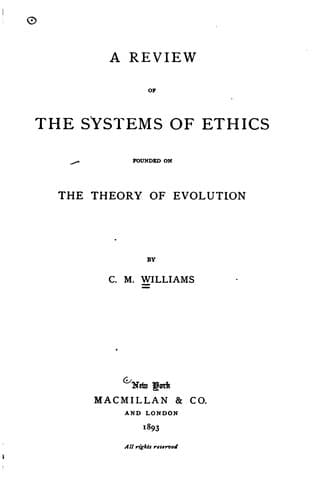
A Review of the Systems of Ethics Founded on the Theory of EvolutionWilliams, Cora May
Philosophy
A Review of the Systems of Ethics Founded on the Theory of Evolution
Williams, Cora May
Ethics, Evolutionary
"With these introductory specifications in mind, let us assume any
number of material particles to be restricted, by forces of some sort,
to motion within limited space, and the system either withdrawn from
outer influences or under such as are constant; let us, moreover,
suppose the system undisturbed by the interference of psychic freedom,
or the latter impossible. In such case, certain initial positions,
velocities, and directions of the parts of the system being assumed, all
following states will be determined by these. And now, if there are
among these conditions, either present at the beginning, or attained in
the course of the motion, any such as have for their result a return of
the same states after a given time, then the motion, and so also the
positions of the parts conceived as at first undergoing alteration in
form and velocity, will, unless they contain the immediate condition of
periodic recurrence, continue altering until those of all the possible
states are reached which contain the condition of recurrence; until this
point is attained, the system will, so to speak, know no rest. Has the
recurrence once taken place within a given time, then it must always
take place anew within the same time, because the same conditions are
there to determine it. And since these conditions are determinative of
the whole course of motion from one recurrence to the next, the same
course must be repeated; that is, in every like phase of the period a
like state of motion will exist. But this gives us full stability of the
system, a change, a deviation from the attained stability being possible
only through changes in outer influences, the assumed constancy of which
rendered the attainment of stability possible.
"This principle appears at first purely _a priori_; but the assumption
should not be overlooked that there are among the conditions determining
the motion such as lead to their own recurrence, and this is to be taken
for granted, since it is necessary to assume that a system must continue
to change until, but only until, the conditions of full stability are
attained, in case it is attainable; and that this full stability, when
once reached, cannot be again destroyed by the action of the system
itself. The question presents itself as to how far calculation and
experience permit us to lay down a more general principle.
Public-domain text, read in full here on John Shaqi.
Reviews
Reviews
No reviews yet
Be the first to share your thoughts on this work.
Elsewhere in the archive
Join the Discussion
Join the discussion
Sign in to leave a comment or review.
Sign InorCreate an account