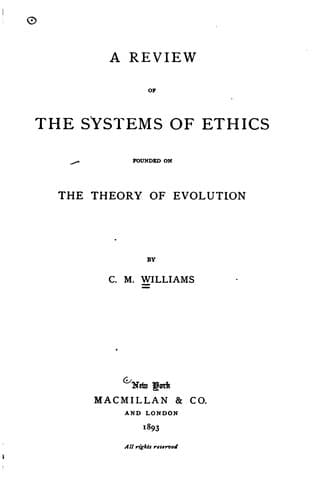
A Review of the Systems of Ethics Founded on the Theory of EvolutionWilliams, Cora May
Philosophy
A Review of the Systems of Ethics Founded on the Theory of Evolution
Williams, Cora May
Ethics, Evolutionary
"In a system in which only two particles or masses, withdrawn from outer
influences, are determined to motion by mutual attraction and the
influence of a primary impulse in another direction, calculation shows
us that, motion to infinity being excluded, the attainment, and indeed
the immediate attainment, of full stability is a necessity; and for
swinging pendula and vibrating strings it may be calculated, from the
nature of the moving forces, that they would remain in a condition of
fully stable motion if outer resistance were removed; for, such
obstacles present, they pass through an approximately stable condition
to one of absolute stability. The power of purely mathematical
calculation does not go beyond such comparatively simple cases....
"But if we call experience to our aid, it may be asserted, in accordance
with very general facts, that, in a system left to itself or under
constant outer conditions, and starting from any conceivable state, if
not full stability at least a greater or less approximation to it is
reached as final condition, from which no retrogression takes place
through the inner workings of the system itself. The tendency to
approximately stable conditions appears, or the actual state is
attained, according to the measure in which variable outer influences
are withdrawn. So that so little is lacking to our hypothesis, that,
although it has at this point to make up for the impossibility of
perfect demonstration, we are nevertheless justified in laying down the
following law or principle:--
"In every system of material parts left to itself or under constant
outer influences, so, then, in the material system of the universe, in
so far as we regard it as isolated, there takes place, motion to
infinity being excluded, a continuous progress from more unstable to
more stable conditions, up to the attainment of a final condition of
full or approximate stability."
From the union of the principle thus stated and that of the conservation
of energy "it follows that no unlimited progress of the universe to
absolute stability, which consists in perfect rest of the parts, can
take place.... The energy manifested in the universe cannot be altered,
in general, in its amount, but only in the form in which it manifests
itself." "It cannot be asserted that the attainment of full stability in
the universe would be the attainment of an eternal rest, but only of the
most perfectly adjusted motions, and therefore such motions as would
give rise to no variations.... But a condition which brings with it
eternal repetition cannot be reached in finite time."
Public-domain text, read in full here on John Shaqi.
Reviews
Reviews
No reviews yet
Be the first to share your thoughts on this work.
Elsewhere in the archive
Join the Discussion
Join the discussion
Sign in to leave a comment or review.
Sign InorCreate an account