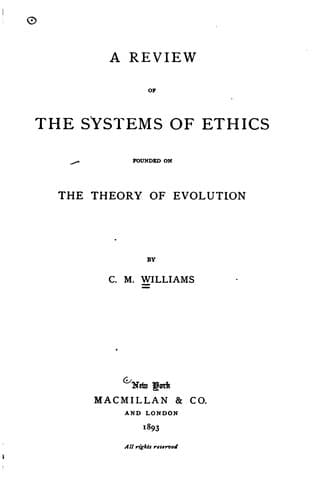
A Review of the Systems of Ethics Founded on the Theory of EvolutionWilliams, Cora May
Philosophy
A Review of the Systems of Ethics Founded on the Theory of Evolution
Williams, Cora May
Ethics, Evolutionary
In the process of evolution towards a stable form of movement,
Dr. Petzoldt recognizes briefly two factors, "Tendency and
Competition."[102] Tendency is defined, in general, as the direction,
actual or potential, of material parts or of mental or physical
function; competition, as the conflict of tendencies, from which a
tendency of a higher order results. "The concept of Competition is, like
that of Tendency, to be taken in a general significance. A number of
forces which act upon a single point compete. Different mental images,
observations, concepts, laws, come into competition, from which result
concepts and laws of lower and higher orders. The struggle for existence
is only a special case of competition. Though this often ends with the
immediate or gradual destruction of systems entering upon it,
nevertheless only a middle worth between all the competing tendencies
can be ascribed to the resultant. Even the conqueror is, after the
struggle, other than what he was before it; a part of the tendency
destroyed by him lives on in him, has combined with his original
tendency to a resultant. Tendencies can as little disappear without
compensation as can forces, whether the compensation consists in a
strengthening or in a weakening of others, and the _conservation of
competing tendencies_ might be regarded as a further qualitative
addition to the law of the conservation of force. Hence, in the
examination of the effects of the struggle for existence, the like
claim of all tendencies taking part in it is not to be left out of
consideration. Each makes its full force felt. But not all attain to
competition; of the numerous tendencies bound up in one organism, only a
few unite, in the single case, to a resultant, which has a direction
towards a definite issue." The less the opposition of competing
tendencies of concepts or laws, the less the deviation of the resultant
from its components, and the less the change these have to undergo. The
higher concepts and laws are, the less are the number of distinguishing
marks which they take from all single conceptions; for they are the
resultants of very strongly opposed components.[103]
Public-domain text, read in full here on John Shaqi.
Reviews
Reviews
No reviews yet
Be the first to share your thoughts on this work.
Elsewhere in the archive
Join the Discussion
Join the discussion
Sign in to leave a comment or review.
Sign InorCreate an account