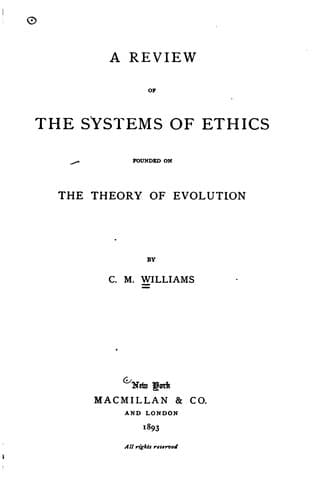
A Review of the Systems of Ethics Founded on the Theory of EvolutionWilliams, Cora May
Philosophy
A Review of the Systems of Ethics Founded on the Theory of Evolution
Williams, Cora May
Ethics, Evolutionary
Dr. Petzoldt criticises, among other things, especially Fechner's
concept of approximate stability, in that no distinction is made by the
author between three different cases. The first case comprises forms of
motion in which periodicity is only approximate, but in which,
nevertheless, no retrogression in stability takes place; this case is
illustrated by our solar system. The second case comprises forms of
motion in which the stability increases up to a certain point, but
beyond this, despite relative constancy in outer conditions, decreases
again until complete destruction of the system supervenes; an
illustration of this form of motion is found in all organisms. The
third case comprises forms of motion which we cannot concede to be
stable. "For, if we ascribe periodic motion to pendula and musical
strings which vibrate in a resisting medium, this is nevertheless a
periodicity, which continually changes _in the same sense_, and we
certainly cannot say that pendula and strings approach, in a resisting
medium, a condition of absolute, through a condition of approximate,
stability. We recognize in these vibrations, decreasing in amplitude,
merely unstable changes which tend toward a final stable
condition,--namely that of rest."
The author finds a further ground of criticism in Fechner's assertion
that organisms are entirely dependent upon the periodicity of their
functions. Only a part of such functions are periodic. Periodicity is
not conceivable without stability, but stability is conceivable without
periodicity.
Public-domain text, read in full here on John Shaqi.
Reviews
Reviews
No reviews yet
Be the first to share your thoughts on this work.
Elsewhere in the archive
Join the Discussion
Join the discussion
Sign in to leave a comment or review.
Sign InorCreate an account