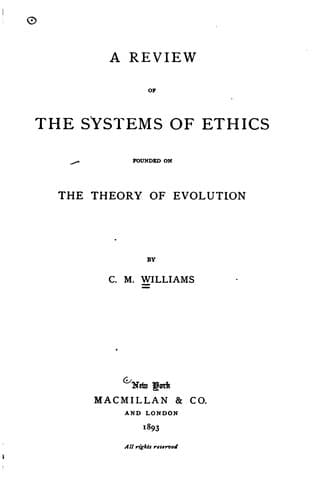
A Review of the Systems of Ethics Founded on the Theory of EvolutionWilliams, Cora May
Philosophy
A Review of the Systems of Ethics Founded on the Theory of Evolution
Williams, Cora May
Ethics, Evolutionary
There is one portion of Fechner's theory as above stated (its
metaphysical phases being beyond the scope of the present chapter have
not been touched upon) that raises a question which may perhaps appear
to have in itself no special significance, but which nevertheless opens
up, by its implications, new fields of inquiry, and may possibly lead to
further theory. The condition of stability which evolution in the
universe as a whole gradually approaches but can never attain to in
finite time is declared, namely, to be one not of rest, but of motion. A
question might be raised, here, as to the definition of the "infinite
time" asserted to be necessary to the attainment of such full
stability,--whether the phrase be used in the mathematical or the
philosophic sense; and the question would be found, I believe, to
involve the unanswerable problem of the finite or infinite character of
the universe in space. Of a universe conceived under the philosophic
concept of spatial infinitude, obviously no final state as the result of
evolution can be predicated, the evolution supposing a progress which,
as involving infinite matter, cannot be accomplished in finite time. If
we, however, conceive the universe as occupying finite space and
undergoing continual evolution as a whole in the direction of
equilibrium, it is a question whether the end must not be attained in
finite time. For a universe conceived as finite, however immense, there
must be a finite number, however great, representing the changes
necessary to the attainment of final equilibrium; and if progress in the
direction of such equilibrium is of necessity continual, the final
equilibrium must be attainable in finite time. The question of the
nature of such a state of final, universal stability is bound up with
the problem of motion through a perfect void, and of the possibility of
the formation of such a void through the concentration of matter.
Leaving out of consideration the problem in its metaphysical form, which
concerns the possibility of conceiving inter-material space, it may be
said that it is not now supposed that the heavenly bodies move through
an absolute void; and the existence of any medium opposing resistance,
however slight, is a condition rendering impossible the attainment of
absolute stability of motion or a full stability which suffers no
diminution and is, therefore, in effect, an absolute stability. It may
be questioned whether the very nature of motion is not coincident with
change, and this with action and reaction, or competition. Such a view
would reduce evolution to a single ultimate principle, in place of
Darwin's Variation and Selection through struggle, or Petzoldt's
Tendency and Competition. We should have left, instead of these, only
the final principle involved in moving matter considered in its ultimate
parts. The metaphysical problem of the infinite divisibility of matter
need not here concern us; the ultimate parts of an organism could not
Public-domain text, read in full here on John Shaqi.
Reviews
Reviews
No reviews yet
Be the first to share your thoughts on this work.
Elsewhere in the archive
Join the Discussion
Join the discussion
Sign in to leave a comment or review.
Sign InorCreate an account