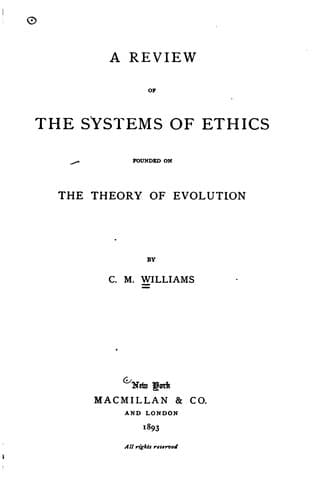
A Review of the Systems of Ethics Founded on the Theory of EvolutionWilliams, Cora May
Philosophy
A Review of the Systems of Ethics Founded on the Theory of Evolution
Williams, Cora May
Ethics, Evolutionary
be, however, its organs as Lewes defined them, but rather, from a
positive standpoint, the ultimate units recognized by science in cell
and cell-parts. We may, indeed, since we know no beginning of motion,
legitimately regard all tendency as itself resultant. Just as we cannot
separate matter and motion, except by abstraction from reality, so, too,
we cannot conceive of motion except as having definite direction; and
thus we arrive, by a final analysis, at the ultimate philosophic
principles of matter and its motion. I use these terms in no
metaphysical sense, but merely as generic terms including under one head
specific forms of material combination and the specific forms of motion
of their wholes or parts.
The question of the character of a conceived state of final equilibrium
may be approached from a somewhat different side, though the emphasis
falls, as before, on the solidarity of the universe and the nature of
motion as change. We may, for instance, regard the earth as an isolated
system whose isolation makes possible the continual progress of the
evolution taking place on its surface. But this whole evolution is, on
the other hand, dependent upon the light and heat of the sun. Again, the
sun is undergoing an evolution whose continuous progress may be regarded
as in a certain sense dependent upon isolation; but we see, on
reflection, that this very process is the result of the cooling nature
of the sun's surroundings, and that it is sending its motion in every
direction through space. The moon, which has passed through both the
evolution that the sun is undergoing and that which is in progress upon
the earth, is now passing through another stage which the earth must
reach in time by diffusion of its atmosphere, in case its destruction is
not accomplished by some catastrophic event before the arrival of that
distant period. Suns and planets, all the heavenly bodies, are sending
their influence in every direction through the unfathomable depths of
space; and just as the capacity of the earth to be warmed by the
influence of the sun involves its reciprocal capacity to act as a
cooling medium for that body, so the conditions throughout the universe
must be regarded as everywhere interdependent and mutually implying one
another. Thus we again arrive finally at a universal action and reaction
among the parts of the universe, all motion implying change of the
direction of motion. Or, since we may and are, in fact, obliged to
regard every direction or form of motion as a resultant,--for of motion
as of matter we know no absolute beginning,--even this simple assumption
may supply us with the conclusion which we have reached in a more
roundabout way. We may regard motion in any direction as counterbalanced
by a resistance in every other direction sufficient to produce it in
this one; in other words, motion takes place at every instant, in the
direction of least resistance, even though this direction may represent,
Public-domain text, read in full here on John Shaqi.
Reviews
Reviews
No reviews yet
Be the first to share your thoughts on this work.
Elsewhere in the archive
Join the Discussion
Join the discussion
Sign in to leave a comment or review.
Sign InorCreate an account