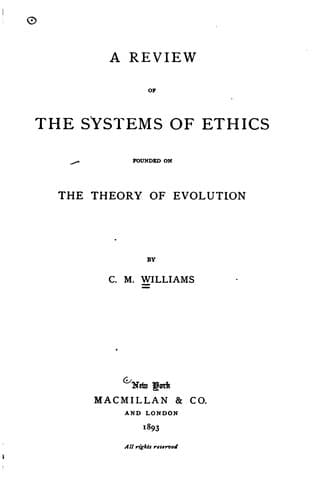
A Review of the Systems of Ethics Founded on the Theory of EvolutionWilliams, Cora May
Philosophy
A Review of the Systems of Ethics Founded on the Theory of Evolution
Williams, Cora May
Ethics, Evolutionary
The periodicity in the life of organic species may be compared to the
wave-motions of light and heat as distinguished from those of water, the
individual representing the single wave-length. The analogy is not,
however, intended--to speak with Bacon--as one of nature, but merely as
one of mind. And just here it may be questioned whether Fechner may not
have been right, after all, in his assertion of the dependency of the
organism upon periodicity of function, whether the periodic character of
the individual life, dependent, as it must be supposed to be, on
adaptation to a medium to some degree resisting, does not sacrifice its
stability in so far as the increments of resistance lack uniformity.
This is evidently the case in large relations; is it not logically
necessary to suppose it so in minute relations, though the fact may not
be so evident to the coarse measurement of the senses? Experience seems
to prove that an approximate periodicity in larger relations, is most
consistent with health; and it must be remembered that the non-periodic
relations are subordinated to periodic ones, that not only in the case
of waking and sleeping, working and eating, but also in those of rest
and labor, a certain uniformity is necessary to the best mental and
physical condition. A close observation will, I think, reveal a greater
periodicity than was at first suspected; since much of it is of
so-called "automatic," "unconscious," or "half-conscious" nature. It is
to be noticed, here, that the termination of individual lives is often
in the nature of a catastrophe, and a uniform periodicity of individual
development and decay cannot be assigned, except in the form of an
average that falls much below the figure attained by the thoroughly
healthy individual. There is every reason to believe that if we could
sleep, rise, eat, bathe, exercise, work, and rest with the regularity of
a clock, we should be the better for it physically. But the
irregularities outside the province of our will-power render it
impossible for us to order our lives in this manner. Nor do we desire to
do so. For these very irregularities, as representing greater or less
change to which adaptation is necessary, are, in many cases and within
certain lines, the conditions and signs of progress; though they may
constitute in other cases and beyond these lines--that is, where they
are of too great intensity or duration--conditions of retrogression, the
imperfection in periodicity becoming catastrophe, which may extend
beyond the individual to his offspring. We may thus infer that the final
destruction of the individual organism is conditioned by its own
progress and the progress of its species, but that on the other hand,
when the destruction of the individual is too abrupt, it may mean
catastrophe to the species also, or at least to a part of it, through
heredity.
Public-domain text, read in full here on John Shaqi.
Reviews
Reviews
No reviews yet
Be the first to share your thoughts on this work.
Elsewhere in the archive
Join the Discussion
Join the discussion
Sign in to leave a comment or review.
Sign InorCreate an account