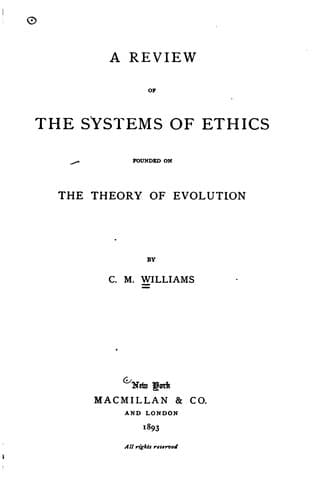
A Review of the Systems of Ethics Founded on the Theory of EvolutionWilliams, Cora May
Philosophy
A Review of the Systems of Ethics Founded on the Theory of Evolution
Williams, Cora May
Ethics, Evolutionary
Our considerations so far have been of a nature to convince us that not
isolation, but a constancy in the continual action of like relatively
small increments of force in the same directions, is the condition of
steady evolution. The less constant and the larger the increments, the
nearer the changes involved resemble catastrophe, though the
catastrophes themselves may be regarded in another light as forming part
of an evolution of a higher order. The changes the sun is undergoing may
be regarded as evolution in so far as the influence of the cooling
medium is a constant one. The earth as a whole and in its parts may be
regarded as passing through a process of evolution towards full
stability in so far as the sun's heat is a constant quantity, the
periodic changes of seasons and of day and night the same. The relation
would seem, therefore, to be one of time--the time-relation involved in
the duration of outer conditions as constant with reference to the
period required for the attainment of stability. Thus the sun's
influence upon the earth might appear approximately constant to the
human individual, but might represent a rapid change in relation to some
stupendous and long-continued evolution in some other part of the
universe. Considerations which we have already noticed forbid our
regarding any conditions of "full" as distinguished from absolute
stability as anything other than peculiar states single in the system
and thus unenduring maxima succeeded by decrease, although the process
may be, with reference to any other particular process, so slow, the
retrogression from the culminating point so gradual, as to be, with
respect to this other process, inappreciable.
And while we are busied with matters which involve the whole
multiplicity of relations in the universe, just a word with reference
to cause and effect. Which one of these myriad material parts
interacting at any moment shall we single out as the cause of the
succeeding state? The solidarity of the universe as far as the complete
interdependence of all its parts is concerned is clear to us. It is true
we cannot reckon with all factors of the universe at once; and the
concept of cause and effect is therefore a useful one. But the cause of
anything must be, from a positive point of view, just what the methods
prescribed for its discovery in any particular case shows it to be:
namely, a factor, merely, in the manifold conditions determining a
following state, the removal of which means the prevention of the
succession of exactly that state. Which, for instance, shall we regard
as the cause of an evil act--the character of a man or the temptation
offered by circumstances? The change or removal of either means the
change or removal of the act. Neither is complete without the other, and
both are involved in the whole complexity of the universe, through
heredity on the one hand and the action of nature external to life on
the other.
Public-domain text, read in full here on John Shaqi.
Reviews
Reviews
No reviews yet
Be the first to share your thoughts on this work.
Elsewhere in the archive
Join the Discussion
Join the discussion
Sign in to leave a comment or review.
Sign InorCreate an account