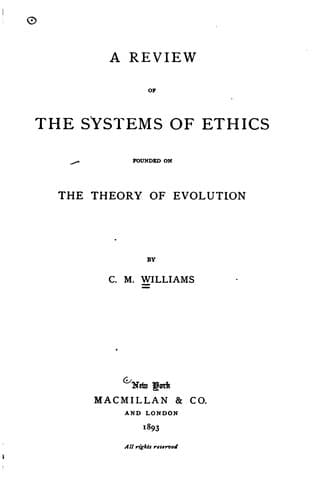
A Review of the Systems of Ethics Founded on the Theory of EvolutionWilliams, Cora May
Philosophy
A Review of the Systems of Ethics Founded on the Theory of Evolution
Williams, Cora May
Ethics, Evolutionary
And just here we may glance at Spencer's definition of life as "the
continual adjustment of inner relations to outer relations." Though
emphasizing an important side of evolution, it is evidently incomplete.
Evolution is not only the adjustment of inner relations to outer
relations, it is also the adjustment of outer relations to inner
relations as well as of inner relations among themselves; or it is a
process of mutual adjustment of all the parts engaged in it.
Our analysis, though crude and imperfect, may now be regarded as
complete. Our scope will not allow of a more elaborate one. It is
fitting, therefore, that we proceed to synthesis. The first matter which
presents itself to us, in this connection, is the theory of Heredity and
Adaptation mentioned above.
The theory is not a new one, wholly outside Darwin's conception of
evolution. The concept of Adaptation represents simply the
generalization of all those special causes with which Darwin more
particularly occupied himself, and is, in essence, only a proclamation
of that universal subjection to natural law which Darwin himself plainly
asserted. As such a. generalization it is, however, a useful one; it
furnishes us with an expression, for the organic world, of that
universal action and reaction through which opposing forces move towards
stability by mutual adjustment.
The law of Heredity, again, may be regarded as an organic expression of
the more general principle according to which motion that, in the sense
defined above, suffers only a minimum of interference, that is, motion
which, by a certain equilibrium of mutual relations, is "approximately"
or "fully" stable, tends to continue to take place in nearly the same
directions, or nearly to repeat itself. It is thus apparent, also, that
Heredity is closely related to the more special principle of Habit, or
also of Use and Disuse, if only we remember that, whatever the
metaphysical truths of Freedom or Determination, the psychical is always
accompanied by what may be called equivalents of the physical under
natural law. The special laws of Heredity are still enveloped in
mystery; I refer, not to that mystery which may be regarded as
surrounding all ultimate facts, if we choose to conceive them as
expressing or concealing something further unknowable, but to the
scientific mystery of ignorance, which time may dissolve. Biologists
disagree on this question, the ultimate decision of which must be left
to them. Still some general criticism on the results of research in this
direction may be allowable from a philosophic standpoint.
Public-domain text, read in full here on John Shaqi.
Reviews
Reviews
No reviews yet
Be the first to share your thoughts on this work.
Elsewhere in the archive
Join the Discussion
Join the discussion
Sign in to leave a comment or review.
Sign InorCreate an account