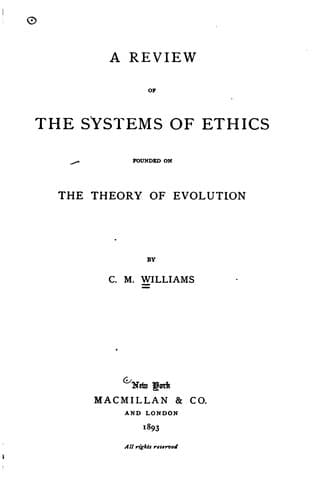
A Review of the Systems of Ethics Founded on the Theory of EvolutionWilliams, Cora May
Philosophy
A Review of the Systems of Ethics Founded on the Theory of Evolution
Williams, Cora May
Ethics, Evolutionary
"In order to convince ourselves of the wonderful power of the sense of
duty among animals, we need only to destroy an ant-hill. Immediately we
see, in the midst of the destruction, thousands of zealous citizens
employed, not in the rescue of their own precious lives, but in the
protection of the beloved community to which they belong. Brave soldiers
of the ant-state prepare to offer strong resistance to our intruding
finger; instructors of youth rescue the so-called ant-eggs, the precious
larvae, on which the future of the state depends; busy workers
immediately begin with undiminished courage to clear away the ruins and
to prepare new dwellings. But the admirable state of civilization among
these ants, among bees and other social animals, has been developed,
just as has been our own, from the rudest beginnings.
"Even those finest and most beautiful forms of human emotion which we
especially celebrate in poetry are to be found prefigured among the
animals. Have not the tender mother-love of the lioness, the touching
affection between male and female parrots, the self-sacrificing fidelity
of the dog, been long proverbial? The noblest emotions of sympathy and
love, which direct action, are here, as with human beings, nothing else
than ennobled instinct." Beginning with this conception, the Ethics of
Evolution has to seek for no new principle, but, on the contrary, to
trace back the old rules of duty to their scientific basis. Long before
the rise of all church-religion, these natural commandments regulated
the lawful relations of human beings, as of gregarious animals. This
significant fact the church-religions should utilize, instead of
disputing. For the future does not belong to that Theology which
declares war against the triumphant Theory of Evolution, but to that
which makes it its own, acknowledges it, and turns it to advantage.
"Far, therefore, from fearing, from the influence of the Theory of
Evolution, a subversion of all accepted moral law and a destructive
emancipation of Egoism, we, on the contrary, look forward to a system of
Ethics erected upon the indestructible foundation of unchanging natural
law, since at the same time with the clear recognition of our true place
in nature, the study of Anthropogeny opens to us the comprehension of
the necessary character of our old rules of duty. Like theoretical
science, Practical Philosophy and Pedagogy will no longer derive their
most important principles from so-called revelations, but from the
scientific truths of Evolution. This victory of Monism over Dualism
opens to us a most hopeful prospect of an unending continuation of our
moral, as of our intellectual evolution. In this sense, we welcome the
Theory of Evolution in its present form newly stated by Darwin, as a
challenge--the most important challenge of pure and applied science."
Public-domain text, read in full here on John Shaqi.
Reviews
Reviews
No reviews yet
Be the first to share your thoughts on this work.
Join the Discussion
Join the discussion
Sign in to leave a comment or review.
Sign InorCreate an account