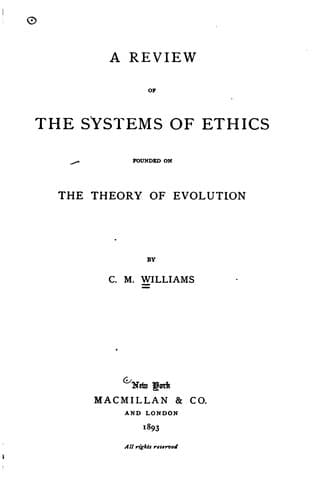
A Review of the Systems of Ethics Founded on the Theory of Evolution — John Shaqi
A Review of the Systems of Ethics Founded on the Theory of EvolutionWilliams, Cora May
Philosophy
A Review of the Systems of Ethics Founded on the Theory of Evolution
Williams, Cora May
Ethics, Evolutionary
Mr. Spencer opens his book with some criticisms of Utilitarianism or the
"Expediency Philosophy." Every rule, in order to be of value, must have
a definite meaning. The rule of "the greatest happiness to the greatest
number" supposes mankind to be unanimous in the definition of the
greatest happiness; the standard of happiness is, however, infinitely
variable, in nations and in individuals. For happiness signifies a
gratified state of all the faculties; and no two individuals are alike
in faculties. In endeavoring to fix a standard, we are met by such
insolvable problems as: What is the ratio between mental and bodily
enjoyments constituting the greatest happiness? Which is most truly an
element in the desired felicity, content or aspiration? The conclusion
we inevitably reach is that a true conception of what human life should
be is possible only to the ideal man,--in whom the component feelings
exist in their normal proportions. The world as yet contains no such
men, and we are left with an insolvable riddle on our hands.
There is the same uncertainty as to the mode of obtaining the greatest
happiness.
The Expediency Philosophy believes that man's intellect is competent to
observe accurately and to grasp at once the multiplied phenomena of life
and derive therefrom the knowledge which shall enable him to say whether
such or such measures will conduce to the greatest happiness of the
greatest number.
If without knowledge of terrestrial phenomena and their laws, Newton had
attempted a theory of planetary and stellar equilibrium, he might have
cogitated to all eternity without result. Such an attempt, however,
would have been far less absurd than the attempt to find out the
principles of public polity by a direct examination of that wonderfully
intricate combination, Society. In order to understand Society it is
necessary to comprehend Man.
Another mistake of the Expediency Philosophy is that it assumes the
eternity of government, which marks a certain stage of civilization, but
which will by no means necessarily last forever. Time was when the
history of a people was the history of its government. Feudalism,
serfdom, slavery,--all were forms of government. Progress means less
government; constitutional forms, political freedom, democracy, all mean
this. Government is a sign of imperfection, an evil necessary against
knavery; it must exist only so long as this exists. The Expediency
Philosophy is, however, founded on government; takes it into
partnership: but a system of moral philosophy professes to be a code of
correct rules for the best, as well as the worst, members of society,
and applicable to humanity in its highest conceivable perfection. Of the
Expediency Philosophy it must, therefore, be said that it can claim no
scientific character, since:
Its fundamental proposition is not an axiom but a problem to be solved;
It is expressed in terms possessing no fixed acceptation;
It would require omniscience to carry it into practice;
Public-domain text, read in full here on John Shaqi.
Reviews
Reviews
No reviews yet
Be the first to share your thoughts on this work.
Join the Discussion
Join the discussion
Sign in to leave a comment or review.
Sign InorCreate an account