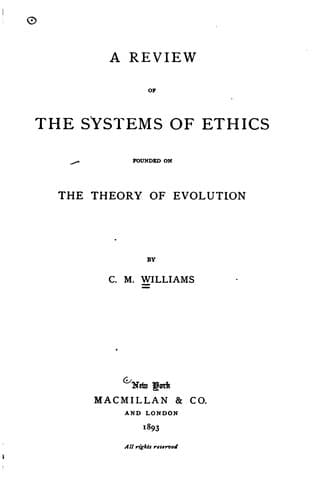
A Review of the Systems of Ethics Founded on the Theory of EvolutionWilliams, Cora May
Philosophy
A Review of the Systems of Ethics Founded on the Theory of Evolution
Williams, Cora May
Ethics, Evolutionary
The "Theory of Population" (published in 1852), which is founded on the
theory of an antagonism between the intellectual and the reproductive
powers, and on the ancient theory of a direct relation between
skull-capacity or brain-size and intellectual power, contains this
passage: "From the beginning, pressure of population has been the
proximate cause of progress. It produced the original diffusion of the
race. It compelled men to abandon predatory habits and take to
agriculture. It led to the clearing of the earth's surface. It forced
men into the social state; made social organization inevitable; and has
developed the social sentiments. It has stimulated to progressive
improvements in production, and to increased skill and intelligence. It
is daily pressing us into closer contact and more mutually dependent
relationships. And after having caused, as it ultimately must, the due
peopling of the globe, and the bringing of all its habitable parts into
the highest state of culture,--after having brought all processes for
the satisfaction of human wants to the greatest perfection,--after
having, at the same time, developed the intellect into complete
competency for its work, and the feelings into complete fitness for
social life,--after having done all this, we see the pressure of
population, as it gradually finishes its work, must gradually bring
itself to an end."
In a letter to Mr. Mill, published in Bain's "Mental and Moral Science"
(p. 721, 3d edition), Spencer repudiates the title of Anti-Utilitarian,
which Mr. Mill, in view of the criticisms of Utilitarianism contained in
"Social Statics," had applied to him. He defines his position in respect
to Utilitarianism as follows: "I have never regarded myself as an
Anti-Utilitarian. My dissent from the doctrine of Utility as commonly
understood, concerns, not the object to be reached by men, but the
method of reaching it. While I admit that happiness is the ultimate end
to be contemplated, I do not admit that it should be the proximate end.
The Expediency Philosophy, having concluded that happiness is a thing to
be achieved, assumes that Morality has no other business than
empirically to generalize the results of conduct, and to supply for the
guidance of conduct nothing more than its empirical generalizations.
Public-domain text, read in full here on John Shaqi.
Reviews
Reviews
No reviews yet
Be the first to share your thoughts on this work.
Join the Discussion
Join the discussion
Sign in to leave a comment or review.
Sign InorCreate an account