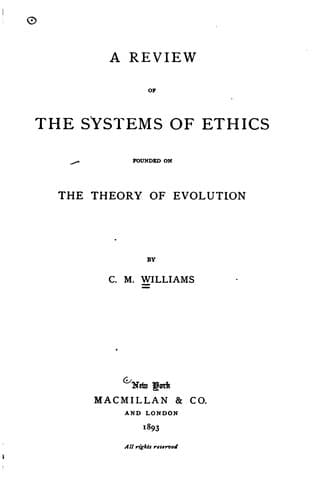
A Review of the Systems of Ethics Founded on the Theory of EvolutionWilliams, Cora May
Philosophy
A Review of the Systems of Ethics Founded on the Theory of Evolution
Williams, Cora May
Ethics, Evolutionary
Out of the three controls of conduct, the political, the religious, and
the social, the first and the last of which are generated in the social
state through the supremacy of individuals in the midst of a control
that is also, in some degree, exerted by the whole community, the moral
consciousness grows; the feeling of moral obligation in general arising
in a manner analogous to that in which abstract ideas are generated, out
of concrete instances. As in such groupings of instances the different
components are mutually cancelled to form the abstract idea, so in
groupings of the emotions, there takes place a mutual cancelling of
diverse components; the common component is made relatively appreciable,
and becomes an abstract feeling. That which the moral feelings--the
feelings that prompt honesty, truthfulness, etc.--have in common, is
complexity and re-representative character. The idea of
authoritativeness has, therefore, come to be connected with feelings
having these traits: the implication being that the lower and simpler
feelings are without authority. Another element--that of
coerciveness--originated from experience of those several forms of
restraint that have established themselves in the course of
civilization--the political, religious, and social. By punishment is
generated the sense of compulsion which the consciousness of duty
includes, and which the word obligation indicates. This sense, however,
becomes indirectly connected with the feelings distinguished as moral;
and slowly fades as these emerge from amidst the political, religious,
and social motives, and become distinct and predominant. The sense of
duty is, therefore, transitory, fading as a motive as pleasure in
right-doing is evolved.
THE SOCIOLOGICAL VIEW
Public-domain text, read in full here on John Shaqi.
Reviews
Reviews
No reviews yet
Be the first to share your thoughts on this work.
Elsewhere in the archive
Join the Discussion
Join the discussion
Sign in to leave a comment or review.
Sign InorCreate an account