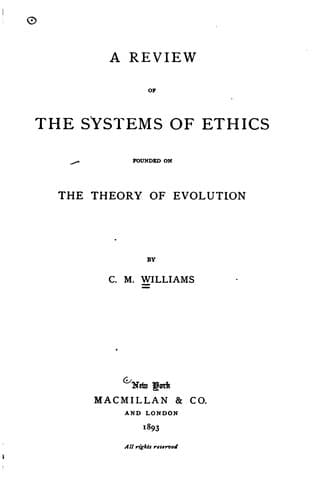
A Review of the Systems of Ethics Founded on the Theory of EvolutionWilliams, Cora May
Philosophy
A Review of the Systems of Ethics Founded on the Theory of Evolution
Williams, Cora May
Ethics, Evolutionary
"Not for the human race only, but for every race, there are laws of
right living. Given its environment and its structure, and there is, for
each kind of creature, a set of actions adapted in their kinds, amounts,
and combinations, to secure the highest conservation its nature
permits." Yet in man we find an additional factor in the formula for
life: for man is sociable to a degree not found anywhere else among
animals. The conditions of the associated state have therefore called
for an emphasizing of those restraints on conduct entailed by the
presence of fellow-men. "From the sociological point of view, then,
Ethics becomes nothing else than a definite account of the forms of
conduct that are fitted to the associated state, in such wise that the
lives of each and all may be the greatest possible, alike in length and
breadth." "But here we are met by a fact which forbids us thus to put in
the foreground the welfare of citizens, individually considered, and
requires us to put in the foreground the welfare of the society as a
whole. The life of the social organism must, as an end, rank above the
lives of its units." These two ends are not harmonious at the outset,
since as long as communities are endangered by rival communities, a
sacrifice of private to public claims is necessary. When, however,
antagonism between communities shall cease, there will cease to be any
public claims at variance with private claims; the need for the
subordination of individual lives to the general life will cease, and
the latter, having from the beginning had furtherance of individual
lives as its ultimate purpose, will come to have this as its proximate
purpose. Between the commands of duty towards members of the same
community and towards those of different communities as between the
sentiments answering to these relations, there is, at present, conflict.
In the course of evolution, however, the various forms of subjection
countenanced by a warlike regime--slavery, the subjection of women to
men, and paternal absolutism, become more and more unpopular, and are
done away with. For each kind and degree of social evolution, there is
an appropriate compromise between the moral code of enmity and that of
amity; this is, for the time being, authoritative.[45] But such
compromise belongs to incomplete conduct; the end of evolution is in the
annihilation of enmity between societies as between individuals. Nor is
a mere abstinence from mutual injury enough. Without cooeperation for
satisfying wants the social state loses its _raison d'etre_. In all
efforts for cooeperation equivalence of exchange is a necessary basis;
all failure to fulfil such equivalence causes antagonism and thus a
diminution of social coherence; in the social, as in the animal
organism, waste without repair destroys the equilibrium of the parts;
fulfilment of contract is, therefore, the primary condition of the
welfare of society.
Public-domain text, read in full here on John Shaqi.
Reviews
Reviews
No reviews yet
Be the first to share your thoughts on this work.
Elsewhere in the archive
Join the Discussion
Join the discussion
Sign in to leave a comment or review.
Sign InorCreate an account