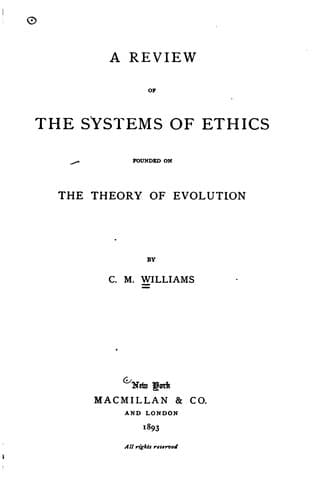
A Review of the Systems of Ethics Founded on the Theory of EvolutionWilliams, Cora May
Philosophy
A Review of the Systems of Ethics Founded on the Theory of Evolution
Williams, Cora May
Ethics, Evolutionary
to be entirely set aside and replaced by other guidance."
The fact cited by Mr. Sidgwick as the "fundamental paradox of hedonism,"
that to get the pleasures of pursuit one must "forget" them, is
explained by the fact that the pleasures of pursuit lie greatly in the
consciousness of capability in the efficient use of means, and the sense
of the admiration excited thereby in others. And so the "fundamental
paradox" disappears. Yet the truth of the pleasure derived from means as
distinguished from ends is of significance. Throughout the evolution of
conduct we find a growing complexity of adjustment of acts to ends, the
interposition of more and more complex means, each as a step to the
next, and leading to the final attainment of even remoter ends. Of
these means, each set, with its accompanying satisfaction, developed
with the function, comes at last to be regarded as proximate end, and
constitutes an obligation; and each later and higher order of means
comes to take precedence in time and authoritativeness of each earlier
and lower order of means. In this manner arises the authoritativeness of
moral requirements, as designating the latest and highest order of
means.
Such means are more determinable than the end--happiness--for any
society. What constitutes happiness is more difficult of determination
than what constitutes the means of its attainment. We may now see our
way to reconciling sundry conflicting ethical theories, which generally
embody portions of the truth, and simply require to be combined in
proper order in order to embody the whole truth. The theological theory
contains a part. If for the divine will, supposed to be supernaturally
revealed, we substitute the naturally revealed end towards which the
Power manifested throughout Evolution works; then, since evolution has
been, and is still, working towards the highest life, it follows that
conformity to those principles by which the highest life is achieved, is
furtherance of that end. The doctrine that perfection or excellence of
nature should be the purpose of pursuit, is in one sense true; for it
tacitly recognizes that ideal form of being which the highest life
implies, and to which evolution tends. There is a truth, also, in the
doctrine that virtue must be the aim; for this is another form of the
doctrine that the aim must be to fulfil the conditions to achievement of
the highest life. That the intuitions of a moral faculty should guide
our conduct is a proposition in which a truth is contained; for these
intuitions are the slowly organized results of experiences received by
the race while living in presence of these conditions. And that
happiness is the supreme end is beyond question true; for it is the
concomitant of that highest life which every theory of moral guidance
has, distinctly or vaguely, in view.
Public-domain text, read in full here on John Shaqi.
Reviews
Reviews
No reviews yet
Be the first to share your thoughts on this work.
Elsewhere in the archive
Join the Discussion
Join the discussion
Sign in to leave a comment or review.
Sign InorCreate an account