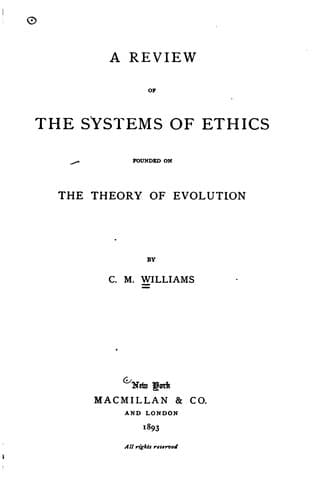
A Review of the Systems of Ethics Founded on the Theory of EvolutionWilliams, Cora May
Philosophy
A Review of the Systems of Ethics Founded on the Theory of Evolution
Williams, Cora May
Ethics, Evolutionary
And even mutual punctiliousness in the fulfilment of contract is not
sufficient to the moral ideal. Daily experience proves that every one
would suffer many evils and lose many goods, did none give him unpaid
assistance. The limit of the evolution of conduct is not reached until,
beyond avoidance of direct and indirect injuries to others, there are
spontaneous efforts to further the welfare of others. The form of nature
which thus adds beneficence to justice, is one which adaptation to the
social state produces. "The social man has not reached that
harmonization of constitution with conditions forming the limit of
evolution, so long as there remains space for the growth of faculties
which, by their exercise, bring positive benefit to others and
satisfaction to self. If the presence of fellow-men, while putting
certain limits to each man's sphere of activity, opens certain other
spheres of activity in which feelings, while achieving their
gratifications, do not diminish but add to the gratifications of others,
then such spheres will inevitably be occupied."[46] But of beneficence,
as well as of justice, sympathy is the root.
The assumption that feelings can be arranged in a scale of
desirability, against which Mr. Sidgwick especially argues in his
objections to (empirical) egoistic hedonism, is not necessarily an
element of such hedonism, although Bentham, in naming intensity,
duration, certainty, and proximity as traits entering into an estimation
of the relative value of a pleasure or pain, has committed himself to
it. But if a debtor who cannot pay offers to compound for his debt by
making over to me any one of various objects of property, will I not
endeavor to estimate their relative value, though I may not be able to
do it exactly; and if I choose wrongly is therefore the ground of choice
to be abandoned? Mr. Sidgwick's argument against empirical hedonism must
tell, moreover, in a still greater degree, against his own
utilitarianism, since this is applicable, not to the individual simply,
but to many classes of differing individuals. To this difficulty must be
added, moreover, the future indeterminateness of the means for obtaining
such universal happiness. Mr. Sidgwick's objection contains, however, a
partial truth; for guidance in the pursuit of happiness through the mere
balancing of pleasures and pains is, if partially practicable throughout
a certain range of conduct, futile throughout a much wider range. "It is
quite consistent to assert that happiness is the ultimate aim of action,
and at the same time to deny that it can be reached by making it the
immediate aim. I go with Mr. Sidgwick as far as the conclusion that 'we
must at least admit the desirability of confirming or correcting the
results of such comparisons (of pleasures and pains) by any other method
upon which we may find reason to rely'; and I then go further, and say
that throughout a large part of conduct guidance by such comparisons is
Public-domain text, read in full here on John Shaqi.
Reviews
Reviews
No reviews yet
Be the first to share your thoughts on this work.
Elsewhere in the archive
Join the Discussion
Join the discussion
Sign in to leave a comment or review.
Sign InorCreate an account