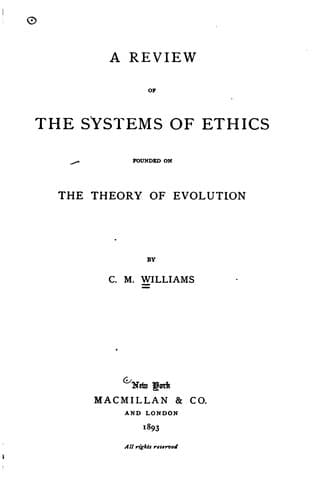
A Review of the Systems of Ethics Founded on the Theory of EvolutionWilliams, Cora May
Philosophy
A Review of the Systems of Ethics Founded on the Theory of Evolution
Williams, Cora May
Ethics, Evolutionary
Here follows a criticism of utilitarianism as one form of pure altruism,
since, according to the utilitarian doctrine, each individual is to
count for one, not more than one, and the individual share of happiness
thus becomes infinitesimal as compared with general happiness. Shall A,
who has, by labor, acquired some material happiness, take the attitude
of a disinterested spectator with regard to their use, as Mr. Mill
recommends? And will he, as such, decide on a division of these means to
happiness with B, C, and D, who have not labored to produce them? From
the conclusion that a really disinterested spectator would not decree
any such division, Spencer seems to draw the conclusion that Mr. Mill's
position is untenable. He further illustrates the untenability of
utilitarianism (as pure altruism) by the figure of a cluster of bodies
generating heat, each of which will have, as long as it generates heat
for itself, a certain amount of proper heat and a certain amount of heat
derived from the others; whereas the whole cluster will become cold as
soon as each ceases to generate heat for itself and depends on the heat
generated by the rest. Utilitarianism involves the further paradox that,
to achieve the greatest sum of happiness, each individual must be more
egoistic than altruistic. "For, speaking generally, sympathetic
pleasures must ever continue less intense than the pleasures with which
there is sympathy." And while the individual must be extremely
unegoistic in that he is willing to yield up the benefit for which he
has labored, he must, at the same time, be extremely egoistic, since he
is so selfish as willingly to let others yield up to him the benefits
they have labored for. "To assume that egoistic pleasures may be
relinquished to any extent is to fall into one of those many errors of
ethical speculation which result from ignoring the laws of biology....
To yield up normal pleasure is to yield up so much life; and there
arises the question:--to what extent may this be done?... Surrender,
carried to a certain point, is extremely mischievous, and to a further
point, fatal."[48] After beginning, however, with this assertion that to
assume that egoistic pleasure may be relinquished to any extent is to
fall, from ignorance of biology, into an error of ethical speculation,
Spencer reaches only the conclusion that, if the individual is to
continue living, he _must_ take "certain amounts" of those pleasures
which go along with the fulfilment of the bodily functions, and that
"the portion of happiness which it is possible for him to yield up for
redistribution is a limited portion." He further argues that "a
perfectly moral law must be one which becomes perfectly practicable as
human nature becomes perfect"; but that the law of utilitarianism does
not so become practicable, since opportunities for practising altruism,
which originate in imperfection in others, will diminish and finally
disappear in the ideal state.
Public-domain text, read in full here on John Shaqi.
Reviews
Reviews
No reviews yet
Be the first to share your thoughts on this work.
Elsewhere in the archive
Join the Discussion
Join the discussion
Sign in to leave a comment or review.
Sign InorCreate an account