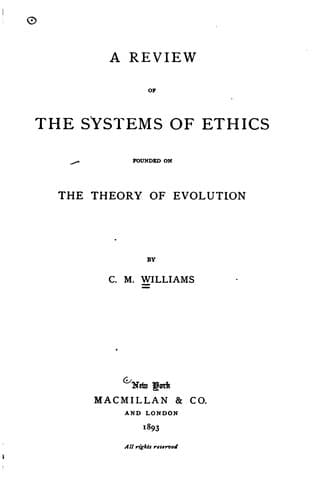
A Review of the Systems of Ethics Founded on the Theory of EvolutionWilliams, Cora May
Philosophy
A Review of the Systems of Ethics Founded on the Theory of Evolution
Williams, Cora May
Ethics, Evolutionary
There is no addition to happiness by
redistribution, and there is the additional labor and loss of time of
such redistribution. The conclusion must be that "general happiness is
to be achieved mainly through the adequate pursuit of their own
happiness by individuals, while reciprocally, the happiness of
individuals is to be achieved in part by their pursuit of the general
happiness." The chapter on the conciliation of altruism and egoism is
occupied with the development of sympathy, as the militant spirit grows
less. The expression of emotion, as also the power of interpreting such
expression, must become greater as the impelling cause to concealment
found in lack of sympathy, disappears. When conditions require any class
of activities to be relatively great, there will arise a relatively
great pleasure accompanying that class of activities; the scope for
altruistic activities will not exceed the desire for altruistic
satisfaction. Such altruistic satisfaction, though in a transfigured
sense egoistic, will not be pursued egoistically--that is, from egoistic
motives. General altruism will resist too great altruism in the
individual, and as the occasion for self-sacrifice disappears, altruism
will take on the ultimate form of sympathy with the pleasure of others
produced by the successful activities of these. And so there will
disappear the apparently permanent opposition between egoism and
altruism.
The last two chapters of "The Data of Ethics" deal with Ethics as the
law of the ideal man in an ideal society, and treat of the attainment of
general principles in this science as in other sciences by the neglect
of conflicting factors, and the recognition of fundamental factors, in
the gradually accumulated knowledge of society. On account of the
diversity of men and societies, a code of perfect personal conduct can
never be made definite; only certain general conditions of perfection
can be pointed out. As life is now carried on, the conflict of claims is
continual; and ethical science, here necessarily empirical, can do no
more than aid in making least objectionable compromises. Absolute
Ethics, which supplies the law of perfect right-doing possible only in
an ideal state, does not greatly aid Relative Ethics, yet it aids
somewhat, as keeping before consciousness an ideal conciliation of
claims, and suggesting search for the best form of compromise possible
under the circumstances.
"Justice," which constitutes Part IV. of "The Principles of Ethics," and
to which "The Data of Ethics" belongs as Part I., was published (1891)
in advance of Parts II. and III. The argument of the book runs as
follows:--
Public-domain text, read in full here on John Shaqi.
Reviews
Reviews
No reviews yet
Be the first to share your thoughts on this work.
Elsewhere in the archive
Join the Discussion
Join the discussion
Sign in to leave a comment or review.
Sign InorCreate an account